Chicago & Illinois Boating Laws & Safety 2025: Safe Guide
Why Understanding Chicago & Illinois Boating Laws Matters
Chicago & Illinois boating laws & safety are essential for anyone on Lake Michigan or the state’s inland waterways. Understanding these regulations keeps everyone safe and helps you avoid serious penalties, from fines to felonies. The state’s Boat Registration and Safety Act governs everything from operator requirements to necessary equipment, and the Illinois Department of Natural Resources (DNR) enforces these laws.
Quick Reference: Key Illinois Boating Requirements
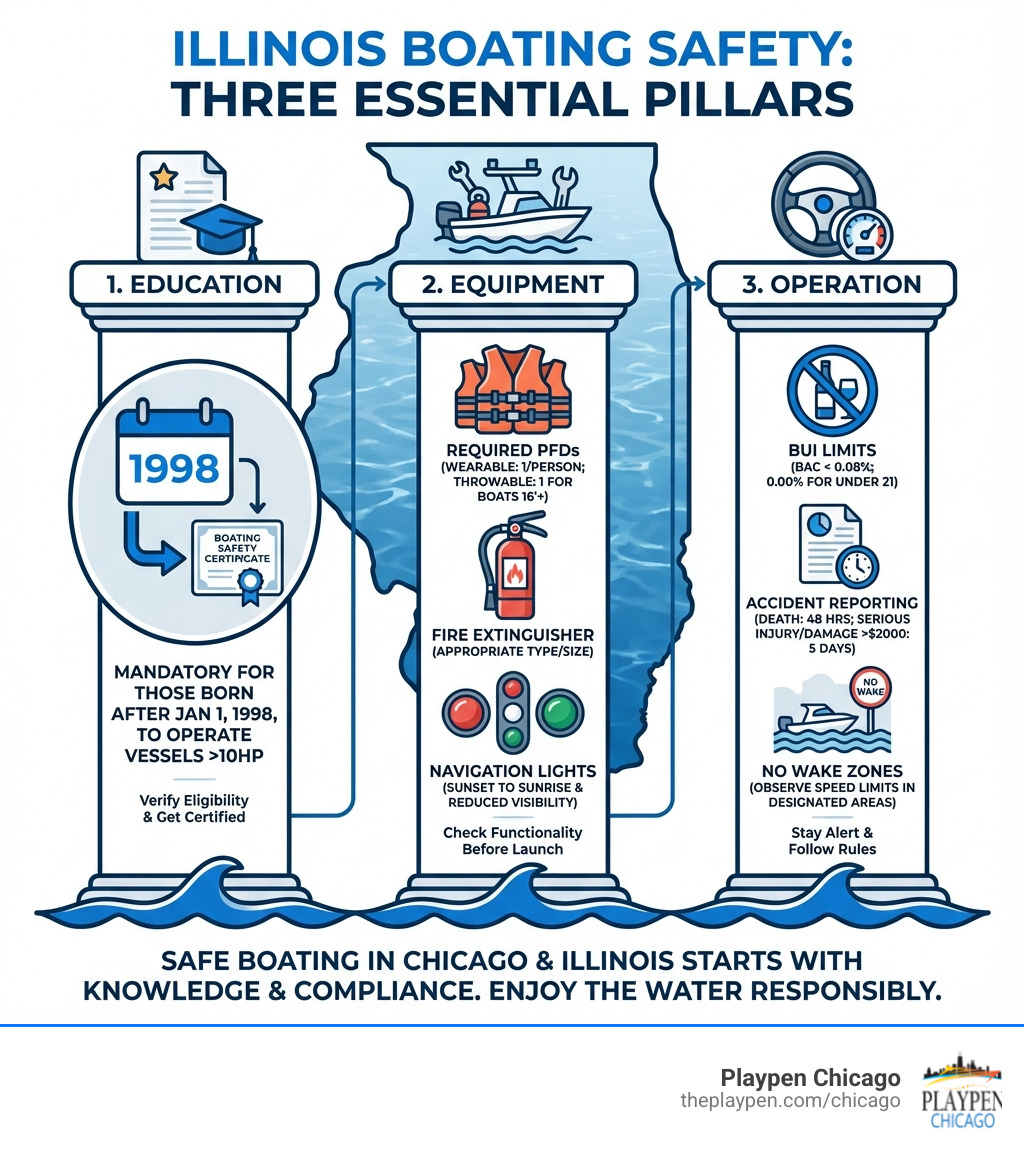
- Age & Education: Persons born after January 1, 1998, need a Boating Safety Certificate to operate vessels over 10 horsepower.
- Safety Equipment: One wearable PFD per person, plus a throwable device for boats 16+ feet; fire extinguisher for internal combustion engines.
- Children: All passengers under 13 must wear a PFD while the boat is underway.
- Alcohol: Blood Alcohol Content (BAC) of 0.08% or higher is illegal; refusal to test results in a 2-year privilege suspension.
- Registration: All motorized vessels require an Illinois Certificate of Number, valid for 3 years.
- Accidents: Report within 48 hours if a death occurs, or within 5 days for other serious incidents or damage over $2,000.
Understanding these regulations is about ensuring your time on the water is safe, legal, and enjoyable. This guide breaks down the essential laws every boater needs to know, from operator requirements and safety equipment to navigation rules and enforcement. Whether you’re planning your first trip to the Playpen or you’re a seasoned boater, staying informed keeps everyone safe.
Operator Requirements: Who Can Legally Drive a Boat in Illinois?
A fundamental part of Chicago & Illinois boating laws & safety is knowing who can legally operate a vessel. This includes age restrictions, supervision rules, and Boating Safety Certificate requirements to ensure everyone enjoys the water responsibly.

Age and Supervision Rules for Young Boaters
Illinois has clear guidelines based on age and motor horsepower to protect young operators and others on the water:
- Under 10 years old: May not operate any motorboat or PWC.
- 10-11 years old: May operate a motorboat over 10 hp only if under the direct on-board supervision of a person over 18 who holds a valid Boating Safety Certificate.
- 12-17 years old: May operate a motorboat over 10 hp if they have a Boating Safety Certificate OR are under the direct on-board supervision of a person over 18 who holds one. Note: If the supervisor was born on or after January 1, 1998, they must also have a certificate.
These rules emphasize that competence and supervision are key to safe boating for minors.
The Illinois Boating Safety Certificate
The Illinois Boating Safety Certificate shows an individual has completed an approved safety course and understands the rules of the water.
- Who needs a certificate? Anyone born on or after January 1, 1998, needs a Boating Safety Certificate to operate a motorboat over 10 hp (including PWCs). While not required for those born before this date, taking a course is always wise. Supervising adults born on or after this date also need a certificate.
- Course options: Courses are available online or in-person. Online courses from approved providers take 4-6 hours and cost $34.95-$59.95. Instructor-led courses are also available. Find options on the Illinois DNR Boating Safety page.
- Certificate validity: The certificate is valid for life. You must carry the card with you on the vessel for inspection, or risk a fine.
- Reciprocity with other states: Illinois recognizes boating education cards from other states and provinces that meet National Association of State Boating Law Administrators (NASBLA) requirements, including Canadian Pleasure Craft Operator Cards.
Gearing Up: Essential Safety Equipment Required on Illinois Waters
Adhering to equipment requirements is a critical part of Chicago & Illinois boating laws & safety. Being prepared for an emergency with the right tools keeps you and your passengers safe.
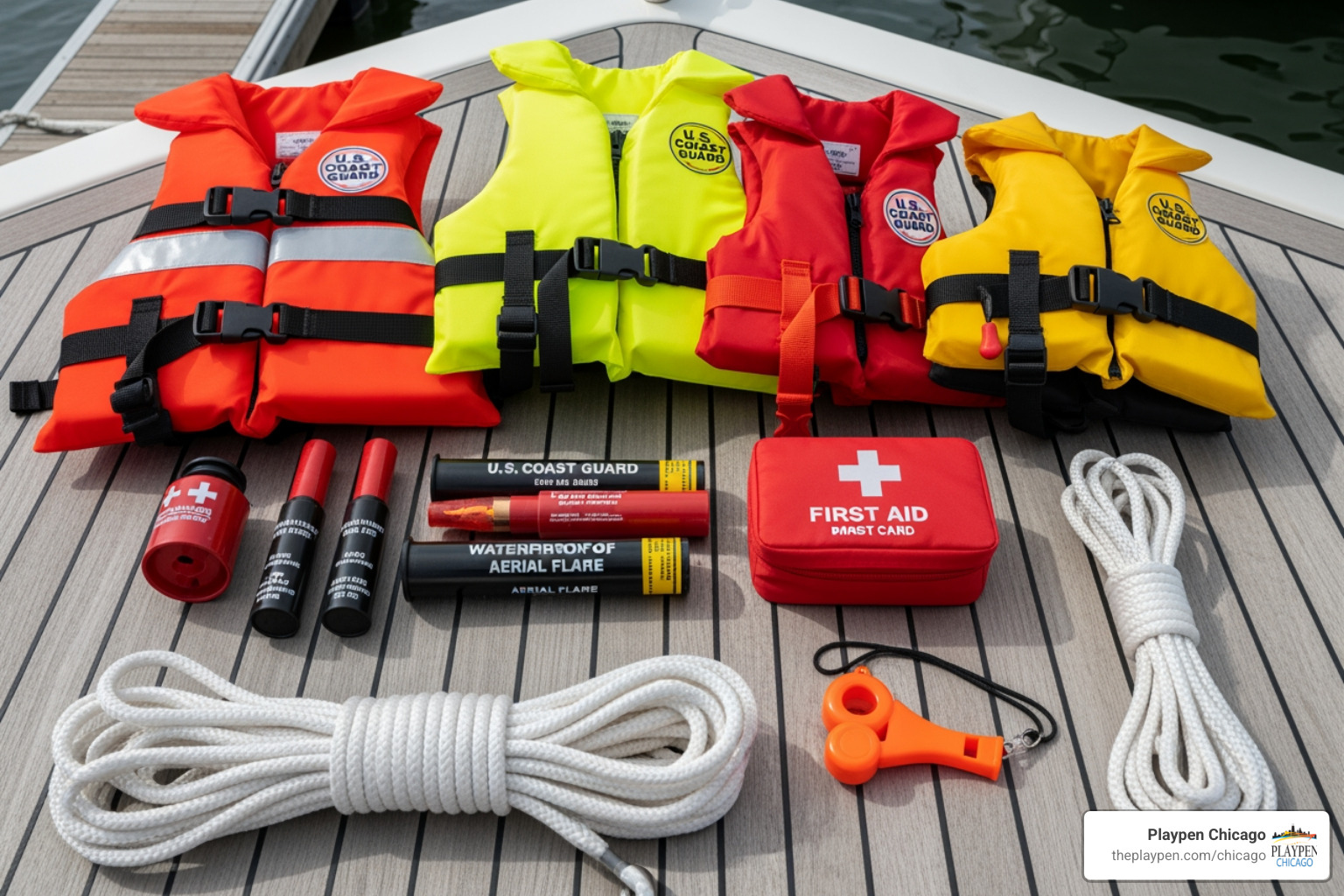
Personal Flotation Devices (PFDs)
Personal Flotation Devices (PFDs), or life jackets, are non-negotiable safety items designed to keep you afloat.
- USCG-approved: All PFDs must be U.S. Coast Guard-approved, in good condition, and readily accessible (not in packaging or locked away).
- Wearable PFDs: One wearable, USCG-approved PFD (Type I, II, III, or V) is required for each person on board or being towed.
- Throwable devices: Vessels 16 feet or longer (except canoes/kayaks) must also have one USCG-approved Type IV throwable device (like a life ring) immediately available.
- Rules for children under 13: Passengers under 13 must wear a properly sized, USCG-approved PFD at all times while on the deck of a boat under 26 feet that is underway. Exceptions include being inside a fully enclosed cabin or on a USCG-inspected charter vessel.
- PWC PFD requirements: Everyone on a PWC must wear a USCG-approved PFD. Inflatable PFDs are generally not approved for PWC use.
- Proper sizing and condition: PFDs must be the correct size for the wearer and in good, serviceable condition to provide adequate flotation.
Lights, Sounds, and Other Critical Gear
Beyond PFDs, other legally required equipment ensures safe operation.
- Navigation lights: Required between sunset and sunrise or during restricted visibility. They help other vessels see you and determine your direction. Power-driven vessels under 65.6 feet need red and green sidelights and an all-around white light or masthead/sternlight combination.
- Visual Distress Signals (VDS): Required on Lake Michigan. These USCG-approved signals (flares, flags, lights) are for signaling for help and must be accessible and in good condition.
- Fire extinguishers: At least one USCG-approved fire extinguisher is required on all vessels with an internal combustion engine. They must be accessible and working. Find details on the USCG Fire Extinguisher Requirements page.
- Ventilation systems: Gasoline-powered vessels that can entrap fumes must have at least two ventilation ducts with cowls. Carbureted engines must also have a backfire flame arrestor.
- Engine Cut-Off Switches (ECOS): It is illegal to operate a motorized vessel with an ECOS unless it is functional. Lanyard-types must be attached to the operator, and wireless systems must be activated. This stops the engine if the operator falls overboard.
- Sound-producing devices: All motorized vessels on state waters need a whistle or other device audible for at least one-half mile. This is crucial on Lake Michigan for signaling.
- Marine Sanitation Devices (MSDs): Discharging sewage into Illinois waters is prohibited. Vessels with an installed toilet must have an operable, USCG-certified MSD.
Rules of the Water: Safe Operation and Navigation
Operating a boat is a tremendous joy, but it demands respect for the water and other users. Understanding the “rules of the road” and operating your vessel responsibly are paramount to Chicago & Illinois boating laws & safety. We all share the water, and safe navigation ensures everyone’s enjoyment.
Towing Skiers and Tubes Safely
Towing activities like waterskiing, wakeboarding, or tubing are popular pastimes on Illinois waters, but they come with specific regulations to ensure everyone’s safety.
- Observer requirements: When your vessel is pulling someone on water skis, aquaplanes, or similar devices, the operator must have a competent person on board to act as an observer. This observer’s primary role is to keep watch over the person being towed, allowing the operator to focus on navigating the vessel safely.
- Skier-down flag: Vessels towing persons must display a skier-towing flag. This flag must be bright orange, at least 12″ x 12″ in size, and displayed from the highest point around the vessel’s helm so that it is visible from all directions. It must be displayed while a person is in the water preparing to be towed, while the person is being towed, and until the person has re-entered the vessel. This alerts other boaters to the presence of a person in the water.
- Permitted towing hours: For safety, towing cannot happen from a half-hour after sunset to a half-hour before sunrise. Reduced visibility during these times makes towing inherently more dangerous.
- Safe distances: Vessels towing persons must maintain a reasonable distance from other persons and property to avoid endangering anyone. It is illegal to operate the vessel or manipulate the towing rope such that the towed device or person collides with any other person or object.
- Manufacturer capacity: All vessels, including PWCs, that are towing a person(s) must be designed and recommended by the manufacturer to accommodate the operator, observer, and person(s) being towed. Overloading is a serious safety hazard.
For more information on safe boating practices and regulations in our area, you can always check out The Playpen Chicago boating resources.
Specific Regulations for Personal Watercraft (PWCs)
Personal Watercraft (PWCs), often called jet skis, are exhilarating but require adherence to specific rules due to their speed and maneuverability.
- PWC age requirements: PWC operators in Illinois must be at least 10 years of age.
- Persons aged 10 to 11 may operate a PWC over 10hp only if they have completed a boat safety course or are under the direct supervision of a parent/guardian or a person over 18 designated by a guardian.
- Persons aged 12 to 17 may operate a PWC over 10hp only if they have a valid Boating Safety Certificate or are under the direct on-board supervision of a person over 18 who has a Boating Safety Certificate.
- PWC hours of operation: Operation of a PWC is prohibited between sunset and sunrise. This mirrors the towing regulations and is designed to prevent accidents in low light conditions.
- Ignition safety switch: PWCs must either be equipped with an ignition safety switch or have a self-circling feature in case the operator falls off. If equipped with a lanyard-type ignition safety switch, the lanyard must be attached to the operator’s person, clothing, or PFD while underway.
- Prohibited maneuvers: Operating a PWC in a careless or reckless manner is strictly forbidden. This includes weaving through congested traffic, jumping the wake of another vessel too closely, or operating too close to other vessels or individuals. These actions create unnecessary hazards.
- PFD usage on PWCs: As mentioned previously, every person riding on a PWC must wear a U.S. Coast Guard-approved wearable personal flotation device.
Operating in Restricted or “No Wake” Zones
Certain areas on the water have special rules to protect swimmers, property, or other vessels.
- “No Wake” zones: These zones require vessels to operate at a “slow, no wake speed,” which means not exceeding 5 miles per hour and producing no wake. This is often enforced near shorelines, marinas, public launching ramps (within 150 feet), and designated swimming areas. Always look for “No Wake” buoys or signs and obey them.
- Restricted areas: It is illegal to operate a vessel within marked bathing, fishing, swimming, or other restricted areas. Always be aware of your surroundings and respect these designated zones.
- Diver-down flags: If you see a diver-down flag (a red flag with a white diagonal stripe) displayed, it indicates that there are divers in the water. We must stay at least 150 feet away from a displayed diver-down flag. It is also unlawful to display a diver-down flag when not diving. Divers must stay within 150 feet of their flag and not surface more than 50 feet away unless in an emergency.
Violations & Enforcement: Chicago & Illinois Boating Laws & Safety
While we always hope for smooth sailing, it’s crucial to understand the serious consequences of violating Chicago & Illinois boating laws & safety regulations. These laws are actively enforced, and penalties can be significant. Ignorance of the law is not an excuse, and we want our community to be fully informed.
Boating Under the Influence (BUI)
Operating a boat under the influence of alcohol or drugs is just as dangerous, and illegal, as driving a car while impaired. Illinois has stringent laws regarding Boating Under the Influence (BUI).
- BAC limit 0.08%: A person is considered to be operating a vessel under the influence if their Blood Alcohol Concentration (BAC) level is 0.08% or higher. This applies to all vessels, including PWCs.
- Drug impairment: It is also illegal to operate a vessel while under the influence of drugs (including prescription or over-the-counter medications that impair judgment) to a degree that renders you incapable of safe operation, or if you have certain controlled substances in your system from unlawful use.
- Implied consent law: By operating a boat or PWC on Illinois waters, you have given “implied” consent to alcohol and/or drug testing if requested by a law enforcement official. This means you automatically agree to submit to chemical tests of your blood, breath, or urine if arrested for operating under the influence.
- Penalties for BUI: A first conviction for BUI can result in a fine of up to $2,500 and/or imprisonment for up to 1 year. Subsequent convictions lead to more severe penalties. If you cause injury or operate with suspended privileges, it can be a Class 4 felony. Causing death while BUI is a Class 2 felony.
- Refusal to test consequences: Refusing to submit to testing will result in an immediate loss of boat operating privileges for a period of 2 years. It’s a significant consequence designed to deter impaired operation.
- Increased penalties: Penalties are increased if a child under 16 years old is on board the vessel while the operator is under the influence. A mandatory minimum fee of $500 and at least 5 days of community service apply in such cases.
Accident Reporting and Law Enforcement
Even with the best precautions, accidents can happen. Knowing the proper procedures for reporting and understanding law enforcement’s authority is vital.
- Reporting requirements: As responsible boaters, we are required to make a written report whenever a boating accident results in:
- Loss of life or disappearance of a person.
- Injury to any person that requires medical treatment beyond first aid.
- Property damage in excess of $2,000.
- Injury or death reporting timeline: Accidents that result in the death of any person must be reported to the DNR by the vessel operator within 48 hours of the accident. All other serious injuries and accidents (property damage over $2,000, non-fatal injuries) must be reported to the DNR within five days. We recommend using the official DNR accident report form.
- Authority to board: Officers of the Illinois Department of Natural Resources, Conservation Police Officers, Sheriffs, deputy sheriffs, and other police officers have the authority to enforce boating laws. They can stop and board your vessel to check for compliance with state and federal laws. It is illegal to refuse to follow the directive of a person with law enforcement authority.
- Yielding to emergency vessels: When being approached by or passing an emergency vessel (like a police or fire boat) using legal visual signals (flashing lights), you must yield or slow to “slow, no wake speed.” Failure to comply can result in the suspension of your boat operating privileges for 3 months up to 2 years.
- The full Boat Registration and Safety Act: For a complete and detailed understanding of all legal provisions, we encourage you to review the official statutes, including The full Boat Registration and Safety Act.
Making it Official: Illinois Boat Registration & Titling
Before we even think about hitting the water, ensuring our vessel is properly registered and titled is a fundamental step in adhering to Chicago & Illinois boating laws & safety. This administrative process confirms ownership, ensures compliance, and contributes to the state’s efforts in waterway maintenance and conservation.
How to Register and Title Your Vessel
The process of registering and titling your boat in Illinois is straightforward, but it requires attention to detail.
- Certificate of Number: All vessels equipped with a motor or sail must have an Illinois Certificate of Number (registration) and expiration decals to legally operate on public waters in Illinois. This certificate must be kept on board and available for inspection by an enforcement officer whenever the boat or PWC is being operated.
- Expiration decals: Once registered, you’ll receive expiration decals that must be properly displayed on your vessel. The identifying numbers must be painted or permanently attached to the forward half of the boat, on both sides of the bow, and must be at least 3 inches high, in block characters, and contrasting color to the hull.
- Certificate of Title: For every owner of a watercraft over 21 feet in length that is required to be numbered by the state, a Certificate of Title is required. Vessels 21 feet and under are not required to have a Certificate of Title, but voluntary titling is permitted.
- Validity period: The boat’s registration is valid for a period of three (3) years. All certificates expire on June 15 of the third year.
- Reporting changes: We need to keep our records current! If you change your address, you must notify the Department of Natural Resources within 15 days of the change. Similarly, if your boat is destroyed, lost, stolen, or ownership is transferred, you must report this to the DNR within 15 days.
- Required documents: To register your boat, you’ll typically need:
- Proof of ownership (e.g., manufacturer’s statement of origin, bill of sale, or out-of-state title).
- A completed Watercraft Application form.
- Payment for the registration and titling fees.
- You can find more information on the Illinois ExploreMore website for first-time boat registration and titling.
- Renewal process: The renewal process is similar to the initial registration. You’ll typically receive a renewal notice and will need to complete a form, provide proof of ownership (if requested), and pay the renewal fee.
- Exemptions: Some vessels are exempt from Illinois registration, including:
- Non-motorized boats like canoes and kayaks (unless they have a sail or motor).
- Boats registered in another state that are used in Illinois for less than 60 consecutive days.
- Boats owned by the U.S. government.
- Federally documented vessels (though they still need to display Illinois expiration decals if used for more than 60 days).
Conclusion
Navigating the waters of Lake Michigan and Illinois’ inland waterways is a cherished experience for many of us in Chicago. By understanding and adhering to Chicago & Illinois boating laws & safety regulations, we ensure that these experiences remain safe, enjoyable, and sustainable for everyone. From mastering age and supervision requirements to outfitting your vessel with essential safety gear and operating responsibly, every rule serves a vital purpose.
We’ve covered the critical aspects:
- Operator Qualifications: Ensuring that anyone at the helm meets age requirements and holds the necessary Boating Safety Certificate.
- Essential Equipment: Equipping your boat with USCG-approved PFDs, fire extinguishers, navigation lights, and other vital safety gear.
- Safe Operation: Adhering to “No Wake” zones, exercising caution when towing, and operating PWCs responsibly.
- Legal Compliance: Understanding the severe consequences of Boating Under the Influence (BUI) and knowing how to report accidents.
- Registration & Titling: Keeping your vessel legally recognized and up-to-date with the state.
These laws are not just arbitrary rules; they are the framework that protects lives, preserves our natural resources, and maintains order on our busy waters. By embracing these responsibilities, we contribute to a culture of safety that benefits our entire boating community.
At Playpen Chicago, we’re passionate about connecting our community with unforgettable on-water and in-city experiences. We believe that a well-informed boater is a safe boater, and a safe boater is a happy boater. Whether you’re listing your boat, offering captain services, or looking for your next adventure on Lake Michigan, being knowledgeable about these laws is your first mate in ensuring a smooth journey.
We invite you to be a part of our vibrant community, where safety and enjoyment go hand-in-hand. For more information, events, and connections within Chicago’s premier boating scene, we encourage you to Join the Playpen Chicago community. Let’s continue to enjoy our magnificent waterways responsibly and safely!