Are bareboat charters legal in chicago? Yes, but only if you follow strict federal, state, and city rules. The legality depends on three key factors:
Chicago’s waterfront offers incredible opportunities for private yacht experiences, but the legal landscape is tricky. Lake Michigan is federal water, which means U.S. Coast Guard rules apply. Add in Illinois state laws and Chicago city ordinances, and you’ve got a regulatory maze that confuses even experienced boaters.
The confusion makes sense. In 2016, the Coast Guard terminated 22 illegal charters near Chicago and issued over $50,000 in citations. More recently, Chicago Harbors stopped offering “Bareboat” permits entirely due to changing Coast Guard guidance. Many operators now avoid the term altogether, even when offering what are technically bareboat arrangements.
This guide cuts through the confusion. We’ll explain what a true bareboat charter actually is, break down the federal, state, and city requirements, and show you how to charter legally—or verify that the charter you’re booking is legitimate.
As the team behind Playpen Chicago, we work with countless boat owners, captains, and charter guests navigating these exact questions about are bareboat charters legal in chicago. Our goal is to help you enjoy Chicago’s stunning waterfront safely and legally.
A bareboat charter, also known as a “demise charter,” is a contractual agreement where the person renting the boat (the “charterer”) takes complete command, control, and possession of the vessel for the duration of the contract. This means we, as the charterers, assume temporary ownership of the boat.

This model is ideal for those who want full control over their itinerary and a more intimate, private experience on Lake Michigan. You can find more information about chartering a boat at the Playpen by visiting our guide on how to charter a boat at the Playpen in Chicago on Lake Michigan: A Complete Guide.
Our Duties as the Charterer:
The Boat Owner’s Duties:
| Aspect | Bareboat Charter (Demise Charter) | Captained (Time) Charter |
|---|---|---|
| Who has control? | Charterer has full command and control | Owner/operator retains control |
| Who hires captain? | Charterer hires and pays captain separately | Owner provides and pays captain |
| Passenger status | Guests not “passengers for hire” if structured correctly | Guests are “passengers for hire” |
| Passenger limits | Up to 12 guests plus charterer (13 total) | Up to 6 on uninspected vessel, more requires COI |
| Liability | Charterer assumes operational responsibility | Owner/operator assumes primary liability |
A “passenger for hire” is anyone on a vessel who has given “consideration” for being aboard. This is why the separation of captain payment is so important.
When we talk about a “bareboat charter,” we’re diving into a specific type of boat rental with unique legal implications. Think of it less like renting a car with a chauffeur and more like renting a car for a road trip where you’re the driver (or you hire your own driver).
A bareboat charter, also known as a “demise charter,” is a contractual agreement where the person renting the boat (the “charterer”) takes complete command, control, and possession of the vessel for the duration of the contract. This means we, as the charterers, assume temporary ownership of the boat. This is a critical distinction because it shifts many responsibilities from the boat owner to us.
Our responsibilities include:
This model is ideal for those who want full control over their itinerary and a more intimate, private experience on Lake Michigan, perhaps for a party of up to ten people. It’s a flexible way to customize our adventure, from cruising past the iconic Chicago skyline to anchoring in the Playpen. You can find more information about chartering a boat at the Playpen, including what to expect, by visiting our guide on How to Charter a Boat at the Playpen in Chicago on Lake Michigan: A Complete Guide.
Understanding who is responsible for what is paramount in a bareboat charter. It’s not just about who holds the keys; it’s about who holds the liability and operational control.
Our Duties as the Charterer:
The Boat Owner’s Duties:
To further clarify, let’s compare bareboat charters with other common types of boat rentals. The distinction often revolves around who controls the vessel and whether passengers are considered “for hire.”
| Aspect | Bareboat Charter (Demise Charter) | Captained (Time) Charter |
|---|---|---|
| Control of vessel | Charterer has full command, control, and possession of the vessel. | Owner or operator retains control and provides transportation service. |
| Who provides crew? | Charterer chooses, hires, and pays captain/crew independently. | Owner/operator provides captain and crew as part of the service. |
| Passenger classification | Guests are not treated as passengers of a commercial service if the charter is structured correctly. | Guests are clearly passengers-for-hire. |
| Typical passenger limits | Up to 12 guests plus the charterer (13 total) on an uninspected passenger vessel. | Often up to 6 passengers on an uninspected “six-pack” vessel, or more only if the vessel is inspected and has a COI. |
| Responsibility & liability | Charterer assumes operational responsibility and significant liability. | Owner/operator assumes primary responsibility and liability for operations. |
In this context, a bareboat charter is an agreement where the charterer essentially rents the boat without a pre-provided crew. We assume full operational control and responsibility. It’s like renting a car: we get the vehicle, and we decide who drives it and where it goes.
A “passenger for hire” is anyone on a vessel (other than the crew) who has given “consideration” for being aboard. “Consideration” means anything that could be interpreted as economically beneficial to the vessel owner, such as direct payment, or even something less tangible like future business or a political favor. This is why the separation of captain payment is so important.
Navigating the waters of Lake Michigan around Chicago requires understanding federal, state, and city regulations. The question of are bareboat charters legal in chicago isn’t a simple yes or no, but rather “yes, if you play by all the rules.”
Lake Michigan falls under federal jurisdiction (U.S. Coast Guard rules), plus Illinois state laws (IDNR) and Chicago municipal codes. For a general overview of boating in our city, check out our Beginner Boating Guide Chicago.
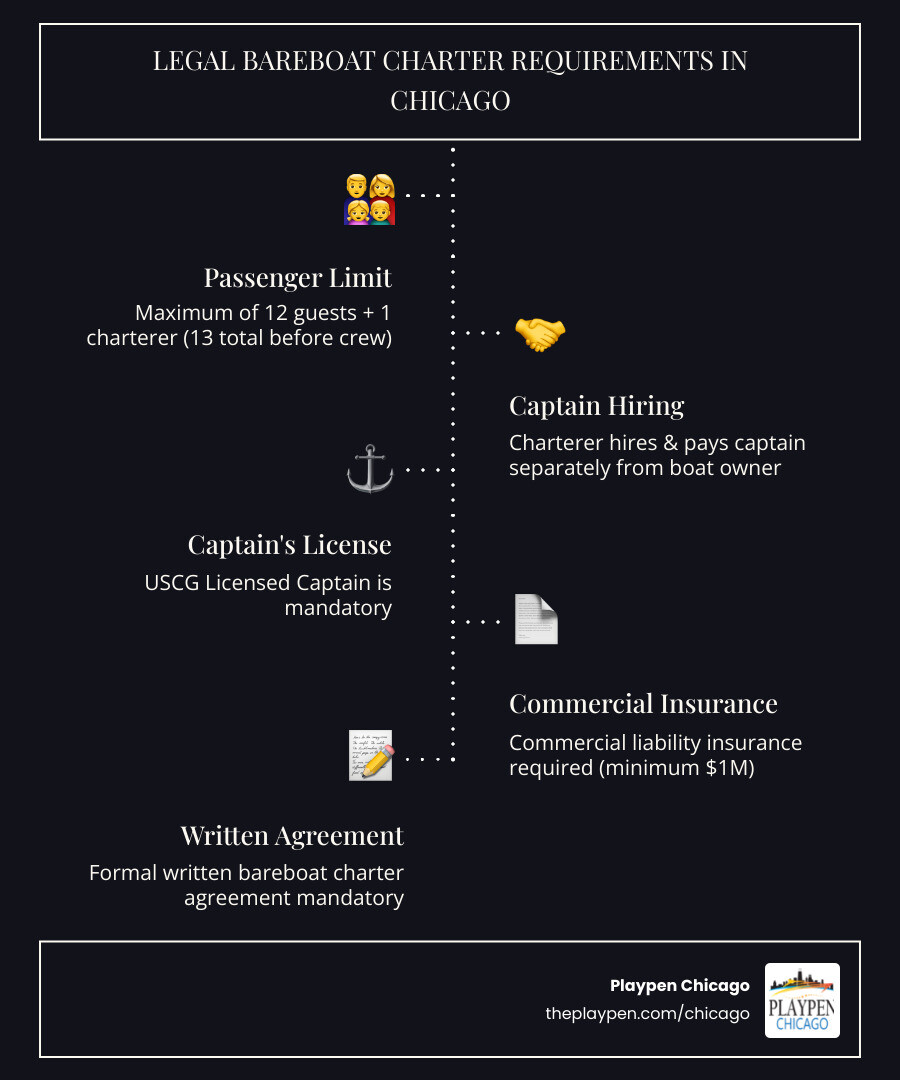
The Passenger Vessel Safety Act of 1993 significantly impacts charter operations. For a true bareboat charter on an “uninspected passenger vessel” (UPV), the key rule is the 12-passenger limit. This means the charterer plus up to 12 guests (13 people total, before any hired crew) can be on board without requiring a Certificate of Inspection (COI). You can dive deeper into these specifics with our guide on USCG Charter Regulations Bareboat Passenger Limits.
Any person operating a vessel for compensation must hold a valid USCG Merchant Mariner’s Credential with a passenger endorsement. Find out more about USCG License Requirements.
The Illinois Boat Registration and Safety Act (625 ILCS 45/) outlines requirements for all watercraft:
The Chicago Municipal Code, Chapter 4-250 mandates licenses for boats carrying passengers for hire. The City requires a Commercial Passenger Vessel (CPV) license ($75 for under 20 passengers, $350 for 20+). Review the Water Taxis/Tour Boats (Commercial Passenger Vessel) Ordinance for details.
Importantly, Chicago Harbors no longer offers Bare Boat or 6 Passenger Permits due to USCG guidance changes. Commercial operators must apply under new permit structures. Our Chicago Harbors Charter Permit Requirements page provides the latest information.
Navigating Chicago’s waters is not just about legality; it’s fundamentally about safety.
The “12-passenger rule” for uninspected bareboat charters means:
Violating this limit can lead to severe penalties. For details, see Understanding Passenger & Crew Limits on Bareboat Charters in Playpen Chicago.
For bareboat charters, tying up to other boats is generally prohibited by local rules to prevent exceeding passenger capacity limits.
We recommend consulting with a marine insurance specialist to ensure your commercial liability policy provides comprehensive protection for your bareboat charter activities and complies with all local harbor requirements.
We often hear similar questions from those eager to experience Lake Michigan through a bareboat charter. Let’s tackle some of the most common ones.
Yes, but with strict conditions. A true bareboat charter, where you (the charterer) take full control and hire your own captain, is legal under federal law. However, the City of Chicago has specific permitting requirements for commercial vessels operating from its harbors. While the “Bare Boat Permit” category is no longer used, operators must still comply with all federal, state, and local regulations under new permit structures.
For an uninspected vessel, the limit is 12 guests plus the charterer (13 total). The captain and any crew you hire are not included in this count. Children and infants count toward the 12-guest limit.
This is the key legal distinction. When you hire and pay the captain directly, you establish “complete command and control,” making it a legitimate bareboat charter. If the boat owner provides or pays the captain, it becomes a “passenger-for-hire” operation, which is subject to much stricter regulations that most rental boats don’t meet. This separation is crucial for compliance. Playpen Chicago makes it easy to Find a USCG Licensed Captain who is qualified and familiar with our local waters.
We often hear similar questions from those eager to experience Lake Michigan through a bareboat charter. Let’s tackle some of the most common ones.
Yes, are bareboat charters legal in chicago is a question with a conditional “yes.” A true bareboat charter, structured correctly, remains legal under federal law. This means that we, as the charterer, assume full command and control of the vessel and independently hire our own USCG-licensed captain.
However, the landscape at the local level has changed significantly. Chicago Harbors will no longer grant permits specifically labeled “Bare Boat” or “6 Passenger Permits” due to updated USCG guidance. This means that while the federal definition allows for bareboat operations, local commercial operators now need to steer new commercial permit structures with the Chicago Park District. It emphasizes the need for boat owners offering vessels for charter to ensure their operations meet all federal, state, and local requirements, even if the specific “bareboat permit” category no longer exists locally.
For a true bareboat charter on an uninspected passenger vessel, the absolute maximum is 12 guests plus the charterer, making a total of 13 people on board. This limit is strictly enforced by the USCG. It’s important to remember that:
Exceeding this limit immediately transforms the vessel into a “passenger vessel” requiring a Certificate of Inspection (COI) and much more stringent regulations, which an uninspected bareboat charter vessel will not have.
This is the cornerstone of a true bareboat charter and the answer to why are bareboat charters legal in chicago under specific conditions. The separation of hiring and payment for the captain is what legally distinguishes a bareboat charter from a “passenger for hire” operation (also known as a “time charter” or “captained charter”).
It might seem like an extra step, but it’s essential for legal compliance and safety. Playpen Chicago makes it easy to Find a USCG Licensed Captain who is qualified and familiar with our local waters.
Navigating Chicago’s vibrant waters on a bareboat charter is an unforgettable experience, and we want to ensure it’s always a legal and safe one. The question of are bareboat charters legal in chicago boils down to understanding and carefully adhering to a multi-layered set of federal, state, and city regulations.
The key takeaways are clear: a true bareboat charter means we take command, we hire and pay our captain separately, and we adhere to strict passenger limits (12 guests plus the charterer on uninspected vessels). While the specific “Bare Boat Permits” are no longer issued by Chicago Harbors, the federal framework for bareboat charters remains, requiring operators to adapt to new commercial permit structures.
Due diligence is our best friend. Always verify licenses, ensure proper insurance is in place, and demand a clear, written bareboat charter agreement. At Playpen Chicago, we are committed to fostering a compliant and enjoyable boating community. Our platform connects you with vetted boat owners and USCG-licensed captains who understand these complexities, making it easier for you to plan your perfect, legal adventure on Lake Michigan.
For a safe and legal boating experience, explore our extensive resources on boat safety and legal compliance. We’re here to help you chart your course legally and confidently, ensuring every moment on the water is nothing short of spectacular.