Chicago Boating Regulations: Essential 2026 Guide
Why Understanding Chicago Boating Regulations Matters More Than Ever
Chicago Boating Regulations are the legal framework for operating a vessel on Lake Michigan, the Chicago River, and the city’s harbor system. Whether you’re renting a yacht for the Playpen or joining friends on the water, knowing these rules is crucial for safety and avoiding fines, permit revocations, or even criminal charges.
Quick Reference: Key Chicago Boating Regulations
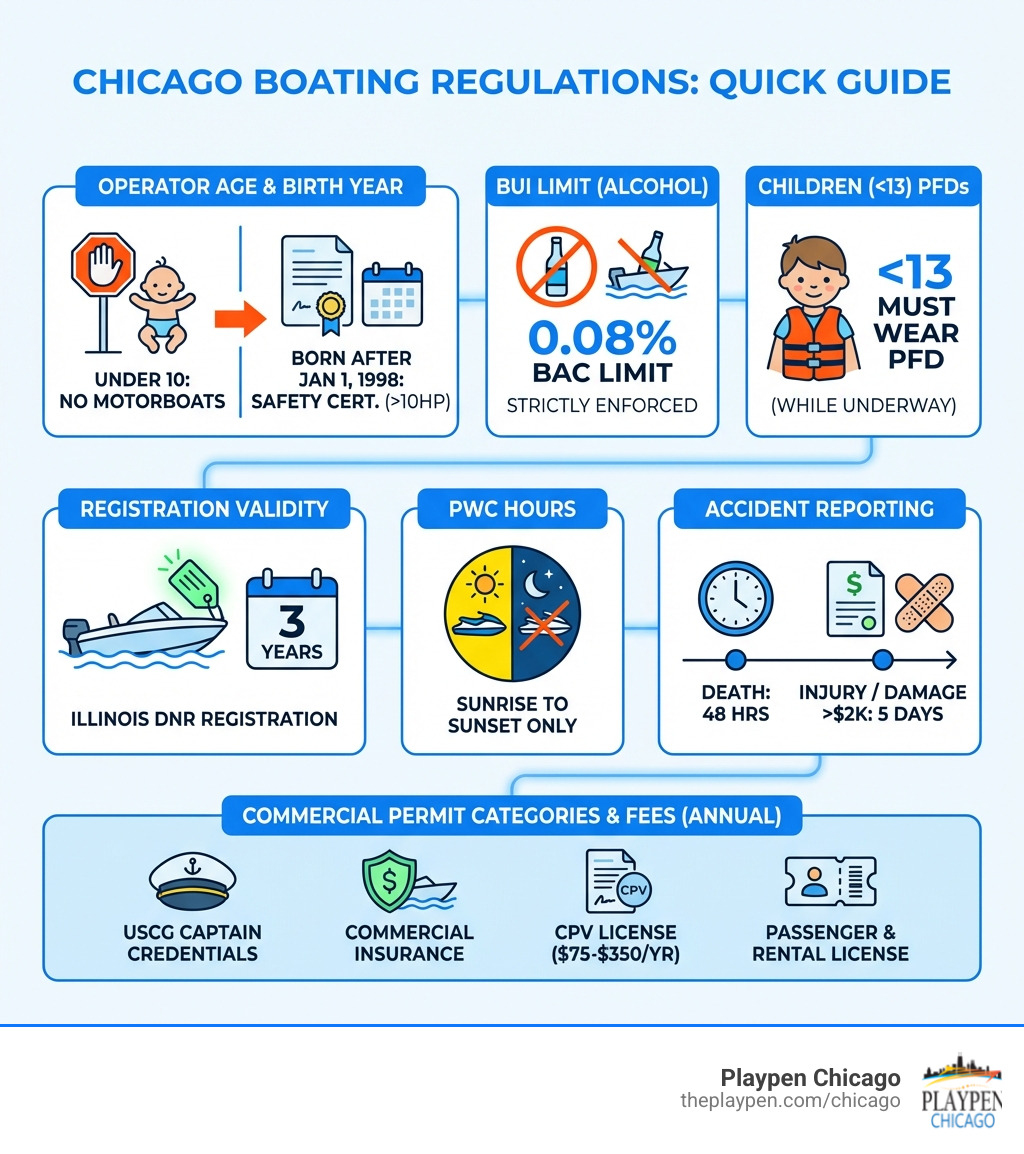
- Age Requirements: No one under 10 may operate a motorboat; those born after January 1, 1998, need a Boating Safety Certificate to operate vessels over 10 horsepower
- Registration: All motorized and sailboats must be registered with Illinois DNR (3-year validity)
- Personal Flotation Devices (PFDs): One USCG-approved PFD per person required; children under 13 must wear PFDs when boat is underway
- Boating Under the Influence (BUI): 0.08% BAC limit; refusal to test results in 2-year operating privilege suspension
- Personal Watercraft (PWCs): Cannot operate between sunset and sunrise; must have engine cut-off switch
- Accident Reporting: Deaths must be reported within 48 hours; property damage over $2,000 or injuries within 5 days
- Commercial Operations: Require CPV license ($75-$350/year), Passenger & Rental Boat License, USCG captain credentials, and commercial insurance
- Chicago Harbors: Commercial permits required; designated pick-up/drop-off zones; new regulations effective 2024
Chicago’s waterfront popularity has surged. The Chicago Harbor Lock is the busiest in the U.S., and the city’s harbor system is the nation’s largest, with over 6,000 boats and high occupancy rates. With thousands of boaters on Lake Michigan and the Chicago River, understanding the rules has never been more critical.
I’m Heidi Auvenshine, Partnership and Marketing Director for Playpen Chicago. I’ve spent years helping boat owners and charter operators steer Chicago Boating Regulations. This guide covers everything from licensing and registration to commercial permits and safety rules, so you can enjoy Chicago’s waterfront with confidence.
Operator & Vessel Requirements: Licensing, Registration, and Documentation
Before casting off, ensure your paperwork and skills are in order. Navigating Chicago’s busy waterways requires understanding Illinois’s specific requirements for operators and vessels.
Age & Education Requirements
One of the most fundamental Chicago Boating Regulations revolves around who can actually operate a boat. Illinois law is quite clear:
- No one under 10 years of age may legally operate any type of motorboat in Illinois. This includes personal watercraft (PWCs).
- If you were born on or after January 1, 1998, you must possess a valid Boating Safety Certificate accepted by the Illinois Department of Natural Resources (DNR) to operate a vessel powered by a motor of more than 10 horsepower. This certificate proves you’ve completed an approved boating safety course and passed an exam.
- For our younger captains, specific supervision rules apply:
- 10-11 year olds may operate a motorboat (over 10 hp) only if under the direct, onboard supervision of a parent, guardian, or an adult (18+) designated by them.
- 12-17 year olds can operate a motorboat (over 10 hp) if they either have a Boating Education Certificate or are under the direct, onboard supervision of a parent, guardian, or an adult (18+) designated by them.
Remembering these age and education requirements is the first step to enjoying the water safely.
You can sign up for the Boating Safety Course here. For more detailed guidance on obtaining your Illinois Boating License, we recommend checking out our comprehensive guide: How to Get Illinois Boating License.
Boat Registration and Titling in Illinois
Like cars, boats in Illinois must be registered and titled. All vessels equipped with either a motor or a sail must be registered to operate on public waters, a key part of Chicago Boating Regulations.
- Certificate of Number: Every boat owner is required to obtain an Illinois Certificate of Number and display expiration decals. This certificate must be on board and available for inspection whenever the boat is in operation.
- Validity: Your boat’s registration is valid for three years, with all certificates expiring on June 15 of the third year. Don’t let it lapse!
- Hull Identification Number (HIN): This unique 12-digit number, assigned by manufacturers to vessels built after 1972, must be prominently displayed and should never be removed or defaced.
- Reporting Changes: If your address changes, you must report it within 15 days. Similarly, if your boat is destroyed or ownership is transferred, the DNR must be notified within 15 days.
The registration process involves completing a Watercraft Application and paying a fee. For more information on how to register, you can also check the Illinois DNR website here.
Specific Rules for Personal Watercraft (PWCs)
Personal Watercraft (PWCs), or jet skis, have their own set of Chicago Boating Regulations due to their speed and maneuverability.
- Age Limits: The minimum age to operate a PWC in Illinois is 10 years old. Those aged 10-11 must be under the direct supervision of a responsible person 18 or older. Operators aged 12-17 need a Boating Safety Education Certificate or must be under direct supervision.
- Sunset to Sunrise Prohibition: Operation of a PWC is strictly prohibited between sunset and sunrise in Illinois.
- Prohibited Maneuvers: PWCs must be operated in a reasonable and prudent manner. This means no weaving through congested traffic, following other vessels too closely, or jumping wakes within 100 feet. Operating a PWC in reverse is also illegal.
- Lanyard/ECOS Requirement: If your PWC is equipped with an ignition safety switch (a “kill switch”), the lanyard must be attached to your person, clothing, or PFD. Alternatively, if it has a wireless engine cut-off switch (ECOS), it must be activated. This ensures the engine stops if you fall off.
- Fire Extinguisher: All PWCs are required to carry a B-1 class fire extinguisher.
These rules are in place to ensure both your safety and the safety of other boaters on the water.
Commercial Operations: Charters, Rentals, and Passenger Vessels
For those in the business of boating—chartering, renting, or carrying passengers for hire—the regulatory landscape is more intricate. Chicago Boating Regulations distinguish between recreational and commercial activities, often requiring additional licenses, inspections, and credentials.
Bareboat Charters vs. Captained Charters
Understanding the difference between bareboat and captained charters is vital, especially with recent guidance changes.
- Bareboat Charter: A bareboat charter is a boat rental without a crew. The person renting (the “charterer”) provides their own licensed captain. Commercial vessels offered this way must be rented as bareboats and should include a list of certified captains for the renter to choose. The captain must hold a valid USCG-issued license.
- Captained Charter: This involves renting a boat that comes with a captain already provided by the charter company.
Important Update for 2024: Due to changes in guidance from the U.S. Coast Guard, Chicago Harbors will no longer grant Bareboat or 6 Passenger Permits in the same way they used to. Current commercial permit holders must submit a new application for the 2024 season following updated guidelines. This is a significant shift, and it’s essential for us to stay informed.
For more detailed insights into these distinctions, especially regarding passenger limits, you can refer to our articles on USCG Charter Regulations Bareboat Passenger Limits and Understanding Passenger Crew Limits on Bareboat Charters in Playpen Chicago.
Licensing for Commercial Passenger Vessels (CPVs) and Rentals
Operating any commercial boating service in Chicago requires specific licenses and compliance.
- Commercial Passenger Vessel (CPV) License: If you’re offering vessels for charter with captains, you’ll need a CPV license from the City of Chicago’s Department of Business Affairs and Consumer Protection (BACP). Annual fees are tiered:
- $75 for vessels carrying 19 passengers or fewer.
- $350 for vessels carrying 20 or more passengers. You can find more information and required documents needed here.
- Passenger & Rental Boat License: For commercial boats that carry passengers or are used for rentals, individuals are also required to acquire a license from the Illinois DNR. This license should be displayed either at your business location or on the vessel. Annual fees are $50 for carrying passengers for hire, and $30 for renting boats for hire (plus a yearly charge per rented boat, based on length).
- USCG Safety Inspections: Any boat carrying 7 or more passengers must pass a safety inspection conducted by the U.S. Coast Guard. This ensures the vessel meets stringent federal safety standards.
Compliance with these licensing requirements is a legal obligation and a commitment to passenger safety. For those looking to ensure they’re always operating legally, especially in popular spots like the Playpen, our guide on Spotting Illegal Charters in Chicago’s Playpen: A 2025 Boater’s Guide offers valuable insights.
Finding a USCG Captain and Commercial Insurance
A properly licensed USCG captain is non-negotiable for any commercial operation where a captain is provided or paid for their services.
- USCG Merchant Mariner’s Credential: Any person captaining a vessel in exchange for payment must hold a valid U.S. Coast Guard Merchant Mariner’s Credential. This credential must include specific authorization for transporting passengers, such as an OUPV (Operator of Uninspected Passenger Vessels, often called a “6-Pack”) or a Master Captain license. These licenses dictate the size of the vessel and the number of passengers you can legally carry.
- Commercial Insurance: Commercial operators must also secure appropriate commercial insurance policies. For operations within Chicago Harbors, this typically includes naming the Chicago Park District as an additional insured.
To obtain a USCG captain license, we recommend reaching out to our partner Mariners Learning System. They offer comprehensive courses to help you earn your credentials. Use promocode GETMYBOAT10 for 10% off all products! For commercial insurance, our partner Boat Charter Insurance can help you obtain a suitable policy. You can also explore our article on USCG License Requirements for more details.
Designated Pick-Up/Drop-Off Locations & Harbor Permits
Operating within the Chicago Park District’s harbor system involves specific rules for commercial permits and passenger handling.
- Commercial Permits: Beyond state and city licenses, commercial operators (including charter services) must obtain a commercial permit from the Chicago Park District for operating services from a boat in Chicago harbors. This involves providing proof of ownership, registration, details on your proposed commercial activity, required state and federal licenses, and meeting insurance requirements.
- 2024 Regulation Changes: As mentioned, Chicago Harbors will no longer grant Bareboat or 6 Passenger Permits in the same way. This means all commercial permit holders need to submit new applications for the 2024 season, adhering to updated guidelines.
- Designated Passenger Zones: The Park District has numerous places that allow for the drop-off and pickup of rental boats and passengers. It’s crucial to confirm these designated zones and their specific policies with the marina or dock before planning your operations.
For the latest information on these changes and how they impact commercial operations, we highly recommend visiting the Chicago Harbors website here. And for practical advice on navigating Chicago’s harbor system, check out our guide on How to Dock Your Boat at a Chicago Harbor and Anchor Safely at the Playpen.
On-the-Water Rules of the Road: Safety and Operations
Once on the water, a different set of Chicago Boating Regulations comes into play. These are the “rules of the road” designed to prevent accidents and ensure a safe experience for everyone.
Essential Safety Equipment Requirements
By law, every vessel in Chicago’s waters must carry specific U.S. Coast Guard (USCG) approved safety equipment.
- Personal Flotation Devices (PFDs):
- All vessels must have at least one USCG-approved, wearable PFD (Type I, II, III, or V) for each person on board or being towed. These must be readily accessible, in good condition, and properly sized.
- PFDs for Children under 13: Critically, all passengers under 13 must wear an approved, correctly-sized PFD on the deck or in the cockpit of a moving vessel under 26 feet. Exceptions include being in an enclosed cabin or on an anchored boat used for swimming or diving.
- Type IV Throwable Device: Vessels 16 feet or longer (excluding canoes and kayaks) must also carry one USCG-approved Type IV (throwable device) PFD.
- Fire Extinguishers: Any boat with an internal combustion engine must be equipped with at least one USCG-approved fire extinguisher. The type and number depend on the vessel’s length and whether it has fixed systems.
- Visual Distress Signals (VDS): Vessels on Lake Michigan must be equipped with USCG-approved visual distress signals, including night signals. Vessels 16 feet or longer must carry day signals as well. These must be readily accessible and in serviceable condition.
- Sound-Producing Devices: All motorized vessels must have a whistle or other device capable of producing a blast audible for at least one-half mile.
- Ventilation Systems: All gasoline-powered vessels constructed in a way that would entrap fumes must have at least two ventilation ducts fitted with cowls to remove fumes.
- Navigation Lights: When operating between sunset and sunrise, or during periods of restricted visibility, all vessels must display appropriate navigation lights.
Keeping our boats equipped and our passengers safe is paramount. For more detailed information on safety equipment, check out our Boat Safety Key guide.
Navigating Chicago’s Waterways: Lake Michigan vs. Chicago River
Chicago offers diverse boating environments, and each has its unique navigational considerations and Chicago Boating Regulations.
- Lake Michigan:
- On Lake Michigan, be prepared for open water conditions and sudden weather changes. Always monitor marine weather forecasts.
- While less restrictive than the river, general rules of navigation (right-of-way, maintaining a safe lookout) apply.
- The Playpen is a popular social hub on Lake Michigan. While there are no specific speed limits within the Playpen, operating at a “slow, no wake speed” is generally expected and prudent due to congestion. Specific anchoring rules apply; you can learn more in Anchoring Rules at the Playpen.
- Chicago River:
- This is a more confined waterway, requiring heightened awareness.
- No Wake Zones: Operating a vessel in no wake areas or within 150 feet of a public launching ramp at greater than a ‘slow, no wake speed’ is illegal. Expect “no wake” throughout most of the Chicago River.
- Restricted Areas: Be mindful of designated swimming, fishing, or restricted areas. Boats are generally prohibited from operating within 150 feet of the shoreline of any land owned by the Park District, or within 300 feet of a bathing beach, with exceptions for emergencies or entering/leaving harbors.
- Commercial Traffic: The Chicago River is home to significant commercial traffic, including tour boats and barges. We must always give way to larger, less maneuverable vessels.
- Bridge Communication: Many bridges on the Chicago River are operable. Use VHF Channel 13 for bridge-to-bridge communications to request openings.
- Chicago Harbor Lock: This is the busiest lock in the US! Be prepared for potential delays and follow all instructions from the lock tenders. Use VHF Channel 14 to contact Chicago Lockmasters.
Prohibited Operations: Careless, Reckless, and Towing Rules
To ensure safety, certain operating behaviors are strictly prohibited under Chicago Boating Regulations.
- Careless or Reckless Operation: This includes a range of dangerous actions:
- Weaving through congested waterway traffic.
- Being too close to another vessel, especially in poor visibility.
- Swerving away from another boat at the last minute or too late to avoid collision.
- Overloading or overpowering a boat.
- Creating hazardous wakes or waves that endanger other vessels or property.
- Towing Individuals: When towing a person (e.g., for water skiing or tubing), specific precautions are necessary:
- A competent observer (at least 13 years old) must be on board in addition to the operator, to watch the person being towed.
- The vessel must be designed to accommodate the operator, observer, and towed person(s) safely.
- Towing Hours: Towing a person behind a boat is prohibited more than 30 minutes before sunrise or 30 minutes after sunset.
- Skier-Towing Flag: A bright orange, at least 12″x12″ skier-towing flag must be displayed from the highest point around the vessel’s helm while towing skiers. This flag signals to other boaters that someone is in the water.
These rules are designed to prevent injuries and accidents. For more on safe water activities, including lily pads and swimming, read our guide: Is it Safe to Jump Off a Boat, Swim or Use a Lily Pad at the Playpen in Chicago? A Comprehensive Guide.
Understanding Chicago Boating Regulations: Violations, Accidents, and BUIs
Despite best intentions, things can go wrong. It’s crucial to understand the consequences of violations and accident reporting procedures. Chicago Boating Regulations are enforced by agencies like the Illinois DNR Conservation Police and the U.S. Coast Guard.
Boating Under the Influence (BUI) in Chicago
Operating a vessel under the influence of alcohol or drugs is incredibly dangerous and carries severe penalties.
- .08 BAC Limit: In Illinois, a boater with a blood alcohol content (BAC) of 0.08% or more is legally presumed to be under the influence of alcohol. This applies to drugs and a combination of alcohol and drugs as well.
- Penalties: BUI convictions can result in significant fines, jail time, and the suspension of your watercraft operating privileges.
- Implied Consent: By operating a vessel on Illinois waters, you give implied consent to alcohol and/or drug testing if requested by law enforcement.
- Breathalyzer Refusal: Refusing a breathalyzer or drug test when requested by law enforcement can lead to an automatic suspension of your watercraft operating privileges for a minimum of 2 years.
We advocate for a zero-tolerance BUI policy. Always designate a sober operator or enjoy refreshments once safely docked.
Reporting Boating Accidents
Knowing what to do after an accident is critical for legal compliance and proper investigation.
- Reporting Triggers: A written report is required for boating accidents that result in:
- Loss of life.
- Disappearance of a person from a vessel.
- Injury requiring medical treatment beyond first aid.
- Property damage exceeding $2,000.
- Reporting Timeline:
- Accidents resulting in death must be reported to the DNR within 48 hours.
- Other serious incidents (injury, disappearance, or property damage over $2,000) must be reported to the DNR within five days.
It’s vital to gather all relevant information at the scene, including details of other vessels involved, witnesses, and any injuries or damage.
Understanding Key Illinois Statutes for Chicago Boating Regulations
The Chicago Boating Regulations discussed are rooted in specific Illinois statutes and local ordinances.
- Illinois Boat Registration and Safety Act (625 ILCS 45/): This comprehensive state law covers everything from vessel registration and equipment requirements to safe operation rules, BUI provisions, and accident reporting. It’s the backbone of boating law in Illinois. You can review the full act for more details here.
- Chicago Park District Harbor Rules (Chapter VIII. – Use of Harbors): For those in Chicago’s municipal harbor system, these rules are also vital. They cover permits, fees, prohibited activities, waste disposal, noise limits, and enforcement actions like fines and impoundment. Violations can result in fines up to $500, with repeated offenses leading to permit revocation or boat impoundment.
Familiarizing ourselves with these legal frameworks helps us understand the “why” behind the rules and ensures we’re always operating within the bounds of the law.
Frequently Asked Questions about Chicago Boating Regulations
Here are answers to common questions about Chicago Boating Regulations.
What are the life jacket rules for kids in Chicago?
In Chicago (and all of Illinois), children under 13 have specific life jacket requirements:
- They must wear an approved and appropriately sized U.S. Coast Guard-approved Personal Flotation Device (PFD).
- This rule applies whenever the boat is underway (moving).
- The PFD must be worn if the child is on the deck or in the cockpit of a vessel less than 26 feet in length.
- The only exceptions are if the child is in an enclosed cabin or on an anchored boat that’s being used for swimming or diving.
When cruising with children, ensure they are wearing their PFDs!
Can I operate a boat on the Chicago River at night?
Yes, most vessels can operate on the Chicago River at night, with these important caveats:
- Navigation Lights are Mandatory: Any vessel operating between sunset and sunrise (or during periods of restricted visibility) must display proper, USCG-approved navigation lights. This typically includes a white all-around light and red/green sidelights for powerboats.
- PWC Operation Prohibited: As mentioned earlier, Personal Watercraft (PWCs) are strictly prohibited from operation between sunset and sunrise.
- Increased Caution: Night operation on the Chicago River, with its bridges, commercial traffic, and sometimes challenging currents, requires heightened caution and experience. Reduced visibility means all operators must be extra vigilant.
Prioritize safety, ensure your vessel is properly lit, and be comfortable with night navigation before heading out after dark.
What’s the biggest change in Chicago charter regulations for 2024?
The most significant change for commercial charter operations in 2024 relates to permits issued by Chicago Harbors:
- No More Bareboat or 6 Passenger Permits: Due to updated guidance from the U.S. Coast Guard, Chicago Harbors will no longer grant Bareboat or 6 Passenger Permits as they previously did.
- New Application Process for All Commercial Permits: This change means that all current commercial permit holders must submit a new application for the 2024 season, adhering to the updated guidelines and requirements.
This is a major shift for charter operators. If you offer commercial charter services, consult the Chicago Harbors official website for the latest information and application procedures.
Conclusion
Navigating Chicago’s vibrant waters offers unparalleled experiences. To enjoy them fully, we must prioritize safety and legal compliance. Adhering to Chicago Boating Regulations is about more than avoiding penalties; it’s about fostering a responsible boating community and protecting our waterways.
Every boater plays a vital role, from proper vessel registration and equipment to understanding commercial operations and BUI rules. The 2024 charter regulation changes highlight the dynamic nature of these laws and the need for continuous education.
We hope this guide has clarified Chicago’s boating laws. By staying informed and practicing safe boating habits, we can all contribute to making Chicago’s waters enjoyable and safe for everyone.
Explore more about safe and legal boating in Chicago and connect with the community by visiting our Boat Safety & Legal guides.