
Don’t Let Your License Expire: Renewing Your Captain’s Credential
Why Captain License Renewal Matters for Professional Mariners
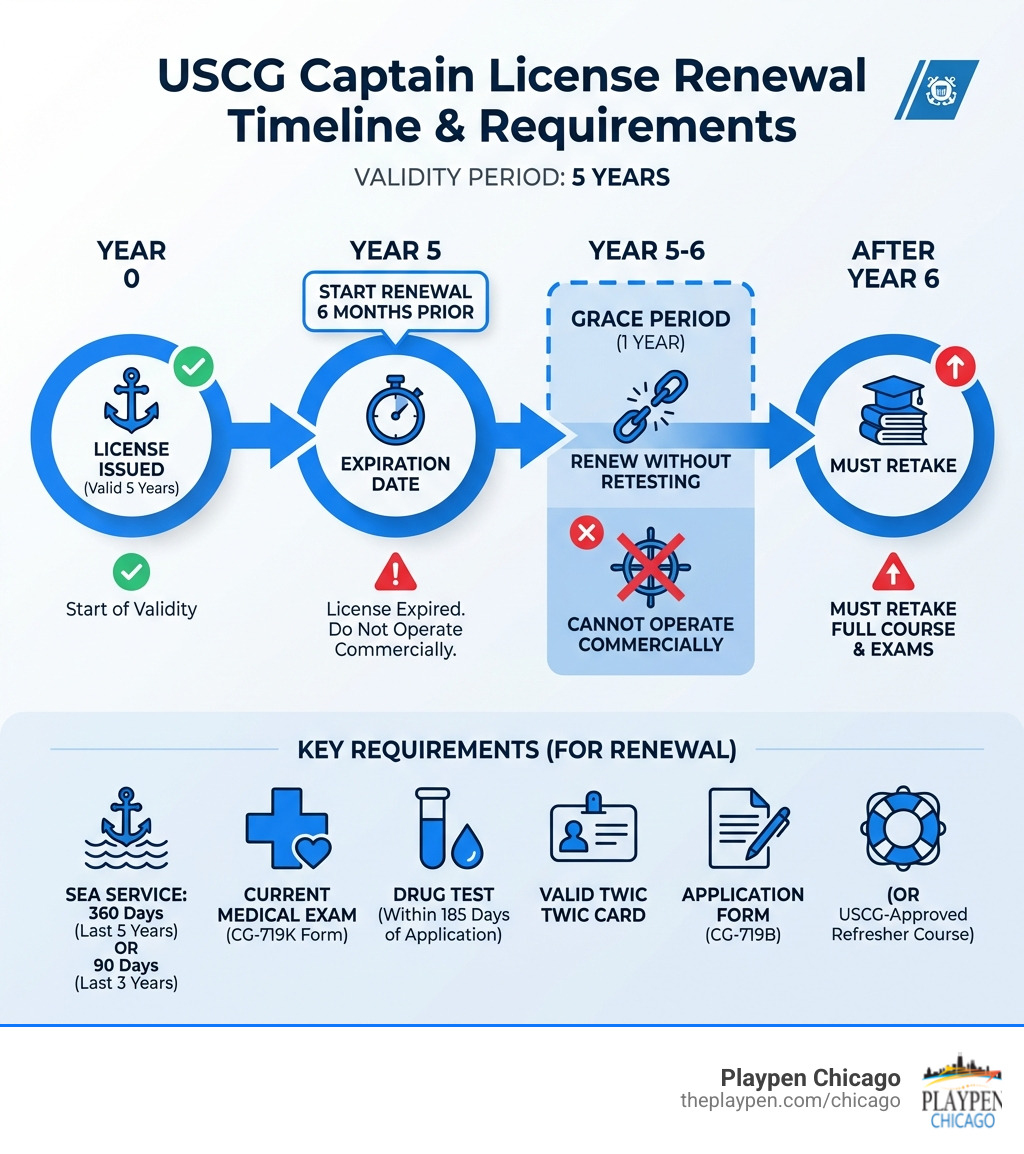
Captain license renewal is required every five years for all USCG-issued Merchant Mariner Credentials (MMC). Here’s what you need to know:
Quick Renewal Requirements:
- Validity Period: 5 years from issuance date
- Sea Service: 360 days in last 5 years (90 days in last 3 years)
- Medical: Current physical exam (CG-719K form)
- Drug Test: Within 185 days of application
- Grace Period: 1 year after expiration (but cannot operate during this time)
- Alternative: Take USCG-approved refresher course if insufficient sea time
Key Forms Needed:
- CG-719B (Application for renewal)
- CG-719S (Sea service documentation)
- CG-719K (Medical certificate)
- TWIC card or exemption memo
As a professional captain, your license is your livelihood. Whether you hold an OUPV “Six-Pack” license for smaller charters or a Master 100 GT license for larger vessels, letting your credential expire can halt your career and force you through the entire licensing process again—including retaking exams—if you miss the grace period.
The renewal process demands careful attention to documentation, timing, and USCG requirements. Processing typically takes 4-6 weeks once your application reaches a Regional Examination Center (REC), so starting early is essential.
I’m Heidi Auvenshine, Partnership and Marketing Director for Playpen Chicago, where I work closely with licensed captains operating charter vessels on Lake Michigan and help steer the complexities of Captain license renewal and maintaining professional credentials. Through our network of experienced mariners, I’ve seen how proper planning makes the renewal process smooth and stress-free.
Essential Requirements for Captain license renewal
Maintaining your USCG captain’s license is paramount for anyone operating commercially, especially on the busy waters of Lake Michigan. The validity period of a USCG captain’s license is five years from its issuance date. This means that every half-decade, we need to gather our documents, verify our sea service, and ensure our medical and drug testing records are up-to-date. Think of it as a professional health check for your maritime career!
The primary requirements for renewing a captain’s license revolve around several key areas: eligibility, medical fitness, drug testing, and maintaining your Transportation Worker Identification Credential (TWIC) card. These elements are non-negotiable and are crucial for ensuring you meet the high safety and operational standards set by the U.S. Coast Guard.
We recommend checking your Merchant Mariner Credential (MMC) for the exact expiration date and starting your renewal process well in advance. The process can take several weeks to months for USCG processing, so proactive planning is our best friend. For comprehensive guidance on all things related to your merchant mariner credential, the National Maritime Center is your official resource.
Documenting Sea Service for Captain license renewal
One of the most critical components of your Captain license renewal is documenting your sea service. This proves that you’ve been actively engaged in maritime operations and have maintained your skills on the water. For both an Operator of Uninspected Passenger Vessels (OUPV, or “Six-Pack”) and a Master 100 GT license, the requirement is to document 360 days of sea service. But here’s the kicker: at least 90 of those days must have occurred within the last three years of your application date.
Sea service is typically documented on the Small Vessel Sea Service Form (CG-719S). This form requires detailed information about your time on various vessels, including vessel name, type, gross tonnage, and the dates you served. If you’ve been operating your own vessel for commercial purposes, such as chartering on Lake Michigan, you’ll need to carefully record your days. Each day counts as at least four hours underway on a vessel under 100 gross tons.
For those of us working in Chicago’s vibrant boating scene, whether on private charters or leading tours, keeping a meticulous log of our sea service is crucial. This isn’t just a bureaucratic hurdle; it’s a testament to our ongoing experience and competence. Accurate and verifiable documentation is key to a smooth renewal. For more detailed information on specific USCG license requirements, including sea service, you can visit our guide on More info about USCG license requirements.
Medical Fitness and Drug Testing Standards
Our physical and mental well-being is paramount when we’re at the helm, responsible for passengers and vessel alike. That’s why medical fitness examinations and drug tests are integral parts of the Captain license renewal process.
For medical fitness, we need to complete the USCG Medical Certificate application, form CG-719K. This form must be completed by a licensed medical professional, such as a primary care physician. The physical examination must be dated within 12 months of your application submission. It assesses various health aspects to ensure you can safely perform the duties of a captain.
Regarding drug testing, federal regulations are strict. You must provide documentation of passing a chemical test for dangerous drugs within 185 days of your application submission. This test must be processed by a Medical Review Officer (MRO) and clearly state “Negative.” Federal law, not state law, governs these tests, so even if certain substances are legal in Illinois, a positive federal drug test will prevent you from obtaining or renewing your license. We recommend contacting services like US Drug Test Centers for scheduling a drug screen at a local lab to ensure compliance. You can find more information on Scientific research on USCG drug testing.
Your TWIC card also plays a role here. While applicants for original licenses must apply for a TWIC and include the receipt in their application, for renewal, you generally need to provide a valid TWIC, recent evidence of applying for one, or a TWIC Exemption Memo. A TWIC is primarily necessary if your work requires unescorted access to secure areas in ports or on vessels.
Completing the Application: Forms and Fees
Navigating the paperwork for your Captain license renewal can feel like charting a course through a dense fog, but with the right guidance, it’s perfectly manageable. The cornerstone of your application is the CG-719B form, officially known as the “Application for Merchant Mariner Credential.” This form needs to be filled out carefully and accurately. A crucial best practice here is to download the CG-719B pdf guide and complete it using an Adobe PDF application after saving it to your desktop. Do not attempt to fill it out in a web browser, as this can lead to errors and submission issues. Remember to name the file clearly, including your last name, first name, and mariner reference number.
Beyond the CG-719B, your application package will include your sea service form (CG-719S), medical certificate (CG-719K), and documentation for your drug test and TWIC card. Once all forms are completed, and you’ve gathered all supporting documents, you’ll need to pay the application fees via Pay.gov. Keep your receipt, as this is part of your submission.

Navigating the One-Year Grace Period
Life happens, and sometimes, despite our best intentions, a license might expire before we can complete the renewal process. The USCG understands this, which is why they offer a one-year grace period, also known as the “continuity period.” This means you can still renew your license for up to one year after its expiration date without having to retake the original exams.
However, and this is a critical point, you cannot operate a vessel commercially once your license has expired, even if you are within this grace period. Operating with an expired license, even for a day, can lead to serious consequences, including fines and potential revocation of your credential. For captains on Lake Michigan, this means any charter operations must cease immediately upon expiration until the renewed license is in hand.
If you find yourself needing to renew during this grace period, the process is largely the same as a standard renewal. The key difference is the urgency. If you let your license expire beyond this one-year window, the renewal course option (in lieu of sea time) may not be sufficient, and you may be required to repeat the original OUPV or Master course and pass the exams again. This is a significantly more arduous and time-consuming process. To avoid this, we encourage timely renewal. For more information on the license reinstatement process, should you find yourself in that unfortunate situation, you can refer to the official More info about license reinstatement.
Electronic Submission and Processing Times
Gone are the days of mailing bulky paper applications! The USCG has acceptd electronic submission, which can streamline the process, provided we follow their specific instructions. Once your complete application packet is assembled, you’ll email it to the Regional Examination Center (REC) nearest you. For our captains in Chicago, this would typically be the REC that serves the Great Lakes region.
When preparing your electronic submission, your package of PDF documents cannot be larger than 35MB, as the USCG email systems will not accept larger attachments. It’s wise to combine related documents into single PDFs where possible (e.g., all sea service forms in one PDF, all medical forms in another) to manage file size. Naming conventions are also important; use your Last Name, First Name, and Mariner Reference Number in the subject line.
Once submitted, the USCG evaluation process typically takes about four to six weeks. However, during peak periods or if there are any discrepancies in your application, it can take longer. This is why we stress starting your renewal early—ideally several months before your expiration date. This buffer allows for any potential back-and-forth with the REC without jeopardizing your ability to operate.
For a successful submission, ensure you follow the USCG Electronic Submission Instructions provided by the National Maritime Center. You can find your Regional Examination Center (REC) online.
Alternatives to Sea Service and License Upgrades
Sometimes, accumulating the required sea service can be a challenge, especially if you’ve had a break from commercial operations or if your opportunities for documented time on the water have been limited. The good news is that the USCG offers alternative methods to fulfill sea service requirements for Captain license renewal. This often comes in the form of approved refresher courses.
These courses are particularly beneficial for captains who may not have the full 360 days of sea time in the last five years. Instead of needing to document every single day, you can enroll in a USCG-approved renewal course. Upon successful completion and passing the associated exams, the course certificate serves in lieu of the sea service requirement. This flexibility ensures that experienced mariners can maintain their credentials even if their recent sea time doesn’t meet the precise criteria.
The renewal process also presents an opportunity to consider license upgrades. For instance, if you currently hold an OUPV (Six-Pack) license and have accumulated enough sea time and experience, you might consider upgrading to a Master 100 GT license. This upgrade would allow you to command inspected vessels carrying more than six passengers, opening up new professional avenues on Lake Michigan. However, an upgrade is a more involved process than a simple renewal and typically requires additional coursework and examinations, rather than just a refresher.
Here’s a quick comparison of renewal requirements for OUPV and Master 100 GT licenses:
| Requirement | OUPV (Six-Pack) Renewal | Master 100 GT Renewal |
|---|---|---|
| Validity | 5 years | 5 years |
| Sea Service | 360 days in last 5 years (90 days in last 3 years) | 360 days in last 5 years (90 days in last 3 years) |
| Alternative | USCG-approved renewal course if insufficient sea time | USCG-approved renewal course if insufficient sea time |
| Medical Exam | Required (CG-719K) | Required (CG-719K) |
| Drug Test | Required (within 185 days) | Required (within 185 days) |
| TWIC | Required (or exemption) | Required (or exemption) |
| Exam for Renewal | Not required if sea service met, or if renewal course taken | Not required if sea service met, or if renewal course taken |
| Consequences of Insufficient Sea Time / No Course | Open book test (if less than 360 days) or full re-examination after grace period | Open book test (if less than 360 days) or full re-examination after grace period |
Using Courses in Lieu of Sea Time for Captain license renewal
For many captains, especially those who might have taken a brief hiatus or shifted their focus, fulfilling the exact sea time requirements can be tricky. This is where USCG-approved courses become a fantastic alternative for your Captain license renewal.
If you cannot show at least 360 days of sea service in the last five years, you can opt to take a renewal course. These courses are designed to refresh your knowledge of navigation, safety, rules of the road, and other critical aspects of maritime operations. They culminate in a proctored exam, which, upon successful completion, provides a Certificate of Training accepted by the USCG in lieu of the sea service documentation.
It’s important to note the validity period for these course certificates. Certificates from courses are generally valid for only one year from the date of completion. This means you must submit your renewal application with the certificate within that one-year window. For example, if you complete a renewal course for a Master 100 GT license, you have 12 months to submit that certificate with your application to the USCG. If you miss this window, the certificate may no longer be valid, and you might need to find another way to meet the requirement.
These courses often feature online learning platforms and can be a convenient option, allowing you to study and take exams from home, which is a great perk for busy captains. While the exams are typically open-book exercises, they still require a thorough understanding of the material. They ensure that even without recent extensive sea time, your knowledge remains current and sharp. For more details on the different types of USCG licenses and how courses can support them, explore our guide on More info about USCG license types.
Frequently Asked Questions about Captain License Renewal
We understand that the Captain license renewal process can raise many questions. Here, we address some of the most common inquiries our Chicago captains have.
How long is a USCG captain’s license valid?
A USCG captain’s license is valid for five years from its issuance date. This applies to all types of licenses, including the OUPV (Six-Pack) and Master licenses. It’s crucial to mark your calendar and start the renewal process well in advance of this five-year expiration to ensure continuous operation.
Can I operate a vessel during the one-year grace period?
No, you cannot operate a vessel commercially during the one-year grace period after your license has expired. While the grace period allows you to renew your license without having to retake the original exams, your credential is considered expired, and operating for hire is illegal during this time. This is a critical distinction that many captains sometimes overlook, leading to potential penalties. Your license must be current and valid to legally command a vessel for commercial purposes on Lake Michigan or anywhere else.
What happens if I have insufficient sea time for renewal?
If you find yourself short on the required 360 days of sea service in the last five years, don’t panic! You have a couple of primary options for your Captain license renewal:
- Take a USCG-approved Renewal Course: This is a popular alternative. Many USCG-approved maritime training schools offer renewal courses that, upon successful completion and passing a proctored exam, will provide you with a certificate that substitutes for the sea time requirement. This certificate is typically valid for one year from the course completion date, so ensure you submit your application promptly.
- Take an Open-Book Test: If you have less than 360 days of sea service but are not taking a renewal course, the USCG may require you to take an open-book take-home test. This test is typically emailed to you after your application is approved and assesses your knowledge of maritime rules and regulations. You usually have a limited time (e.g., 90 days) to complete it and may have a few attempts before needing to re-pay examination fees.
Failing to meet the sea time requirement and not utilizing one of these alternatives, especially if you fall outside the one-year grace period, could mean you have to repeat the entire original licensing course and exams, which is a much more extensive and costly undertaking.
Conclusion
Navigating the waters of Captain license renewal doesn’t have to be a daunting journey. By understanding the requirements, staying organized with your documentation, and planning ahead, you can ensure your credential remains active, keeping your career afloat on Lake Michigan and beyond. Your license is more than just a piece of paper; it’s a testament to your professionalism, your commitment to safety, and your legal authority to command.
Maintaining your captain’s license is a cornerstone of career longevity in the maritime industry. It signifies your dedication and opens doors to professional networking opportunities, especially in a busy hub like Chicago. At Playpen Chicago, we are deeply invested in supporting our local mariner community. We understand the unique demands of operating on Lake Michigan and the importance of having qualified, licensed captains.
Our platform connects skilled USCG-licensed captains with incredible opportunities, from bareboat rentals to premium on-water experiences. We believe in empowering our captains by providing a robust marketplace to list their services, connect with boat owners, and reach a community eager for unforgettable experiences on the water.
Ready to take your professional journey further? Join The Playpen Chicago Captain Network and explore how we can help you amplify your presence and secure exciting opportunities. For more insights and resources on all things USCG captain-related, dive into our USCG Captains Category on our website. We’re here to help you steer your maritime career with confidence!