
Is the Playpen Safe? A Responsible Boater’s Guide to Chicago’s Favorite Spot
Why Chicago Playpen Safety Tips Matter for Every Boater
Chicago playpen safety tips are essential for anyone planning to enjoy the iconic boating sanctuary nestled between Oak Street Beach and Navy Pier. Whether you’re a first-time charter guest or a seasoned boat owner, understanding the unique safety considerations of this protected waterfront area ensures everyone aboard has a memorable—and safe—experience.
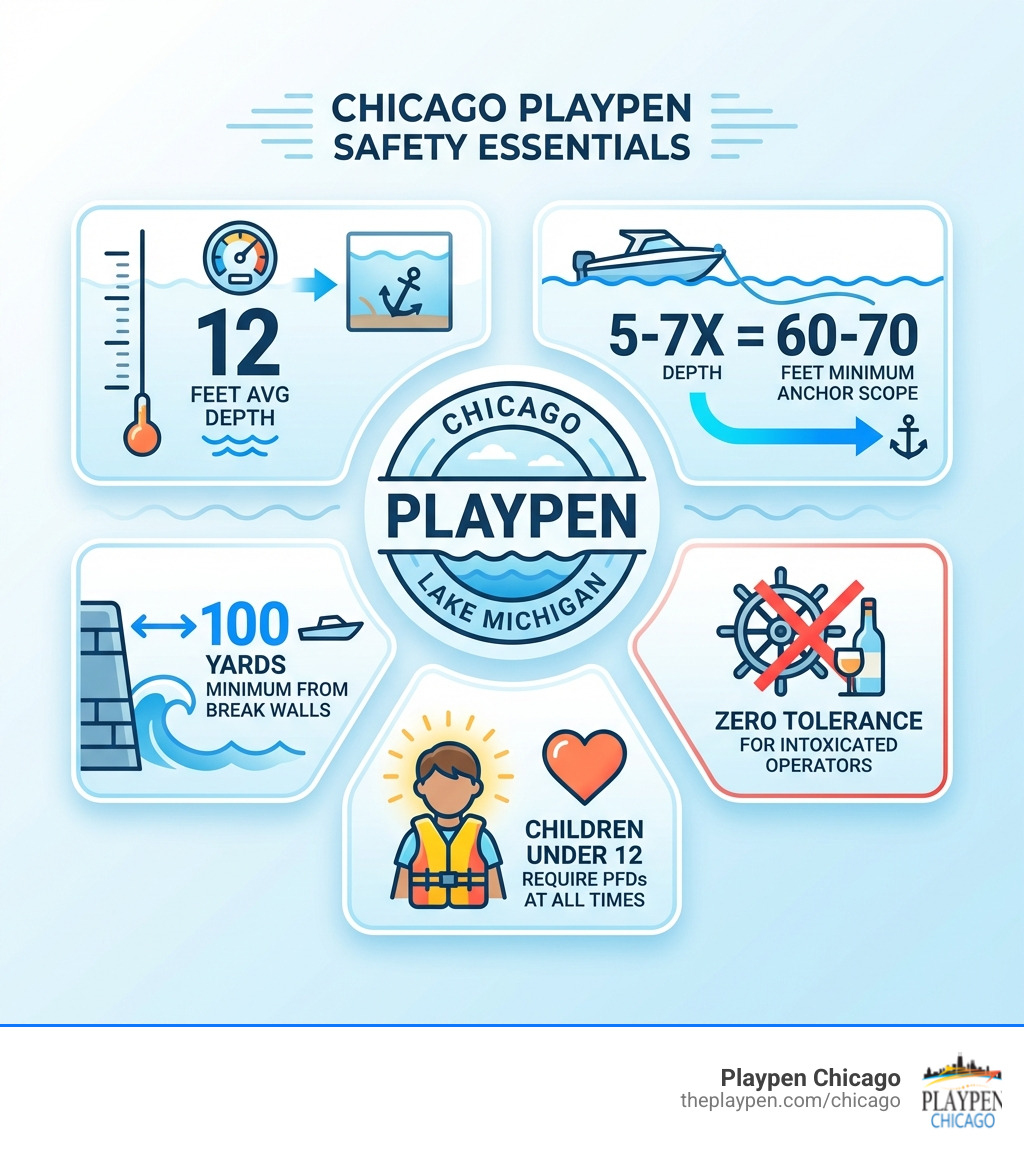
Quick Safety Essentials for the Chicago Playpen:
- Life Jackets Always – All children under 12 must wear a Coast Guard-approved PFD at all times. Have enough for every passenger, plus extras.
- Zero Tolerance for Alcohol – Operating a boat while intoxicated carries severe penalties and puts everyone at risk.
- Anchor Properly – Use 5-7 times the water depth in anchor scope (60+ feet in the Playpen’s average 12-foot depth).
- Maintain Safe Distance – Stay at least 100 yards from break walls and shorelines in case of power loss.
- Check Weather First – Winds over 20 MPH make docking dangerous for new boaters; 25+ MPH triggers small craft advisories.
- Never Boat Alone – Always have a designated, sober operator and train at least one guest in basic boat handling.
- Respect Congestion – Never back up more than a few feet in crowded areas where swimmers may be present.
The Playpen’s tranquil, protected waters create a vibrant community where strangers become friends—but that same popularity demands heightened awareness and responsibility. Proper anchoring techniques prevent your boat from drifting into others. Understanding navigation rules keeps everyone moving safely. Recognizing the signs of cold water shock or drowning can save lives.
I’m Heidi Auvenshine, Partnership and Marketing Director for Playpen Chicago, and I’ve spent years connecting boaters with safe, premium on-the-water experiences while promoting essential chicago playpen safety tips throughout our community. My work with local operators and industry insiders has shown me that the best days on Lake Michigan start with preparation and respect for the water.
Navigating the Playpen: Pre-Departure and On-Water Rules
When we head out to the Playpen, we’re not just going for a casual drive; we’re commanding a vessel on Lake Michigan, a dynamic environment that demands respect and preparation. That’s why understanding and implementing robust chicago playpen safety tips is paramount.
For new boaters or those who haven’t been on the water in a while, we highly recommend taking a boating safety class or watching educational videos online. Driving a boat is inherently more challenging than driving a car. You don’t have brake lights or lanes, and you’re constantly battling wind and current. A solid foundation in boating safety can make all the difference.
Before we even leave the dock, we make sure to perform thorough pre-departure checks. This includes ensuring we have sufficient fuel, that waste tanks are empty, and that we’ve packed plenty of food, drinks, and fresh water. Just like packing for a road trip, having all our essentials means fewer worries once we’re out on the water.
Weather forecasts are our best friend. We always check the wind direction, wave height, and water temperature before and during our trip. Wind direction directly impacts the currents we might encounter. For instance, if winds are over 20 MPH, new boaters might find docking extremely difficult and dangerous, so it’s often best to stay put. A small craft advisory is issued for winds over 24 MPH, and a gale warning for winds over 39 MPH. If there’s any doubt about the weather or water conditions, we don’t go out. Safety first, fun second!
Understanding navigation rules is crucial for avoiding collisions. The “Red on the Right when Returning” (RRR) rule helps us steer harbors and break walls safely. We also ensure our navigation lights are working perfectly, especially if we plan to be out after sunset. Night boating in Chicago can be challenging due to the lack of visual cues and the constant movement of other vessels. If you’re new to boating, we suggest getting very familiar with the waters before attempting night operations. A marine GPS or navigation app like Navionics can be an invaluable tool, and radar is a great idea for night boating or crowded events like fireworks.
For those who prefer to leave the navigation to the experts, hiring a USCG-licensed captain is a fantastic option. They possess the knowledge and experience to ensure a safe and enjoyable trip. Conversely, we must be vigilant about spotting illegal charters, as they often operate without proper licensing or insurance, putting passengers at significant risk. You can find more comprehensive safe boating tips on our website to ensure a smooth journey.
Staying Sober and Alert on the Water
One of the most critical chicago playpen safety tips is maintaining sobriety while operating a boat. We have a zero-tolerance policy for drinking and boating. Unlike driving, boating under the influence (BUI) is often considered a much more serious offense than driving under the influence (DUI), carrying severe financial penalties and potentially life-threatening consequences. The water exaggerates the effects of alcohol, impairing judgment and reaction time even more than on land.
We always designate a sober operator for every outing. This ensures that someone is always alert and capable of handling the vessel and responding to any emergencies. As captains, we are responsible for the safety of our guests, and that includes ensuring everyone on board understands the importance of sobriety for the operator.
In case of an emergency, clear communication is vital. We make sure at least two guests are trained in basic boat handling, anchoring, docking, and how to use the VHF radio or cell phone to call for help. If an assisting guest becomes intoxicated, we must make sure another sober person can step in. Their safety, and the safety of everyone else on board, depends on it. For more insights on this, check out our beginner boating guide.
Understanding Charter Regulations and Passenger Limits
When chartering a boat in the Playpen, understanding USCG regulations is another key element of chicago playpen safety tips. These regulations are in place to protect everyone on board. Bareboat charters, where the person renting the boat is considered the “owner” for the duration of the rental and is responsible for providing the captain, have specific rules regarding passenger limits.
Passenger limits are determined by the vessel’s size, design, and safety equipment. It’s not just about how many people can physically fit on the boat; it’s about how many can be safely accommodated with life jackets, emergency exits, and stability considerations. For example, a bareboat charter typically limits the number of passengers to 12. We always ensure that we adhere strictly to these limits. Overloading a boat compromises its stability and safety, especially in the event of unexpected waves or maneuvers.
We also consider crew limits, ensuring that there are enough competent individuals on board to assist the captain and manage any situations that may arise. For a detailed breakdown of these regulations, we recommend reviewing the USCG charter regulations and understanding passenger and crew limits on bareboat charters in Playpen Chicago.
The Social Scene: Anchoring, Swimming, and Party Etiquette
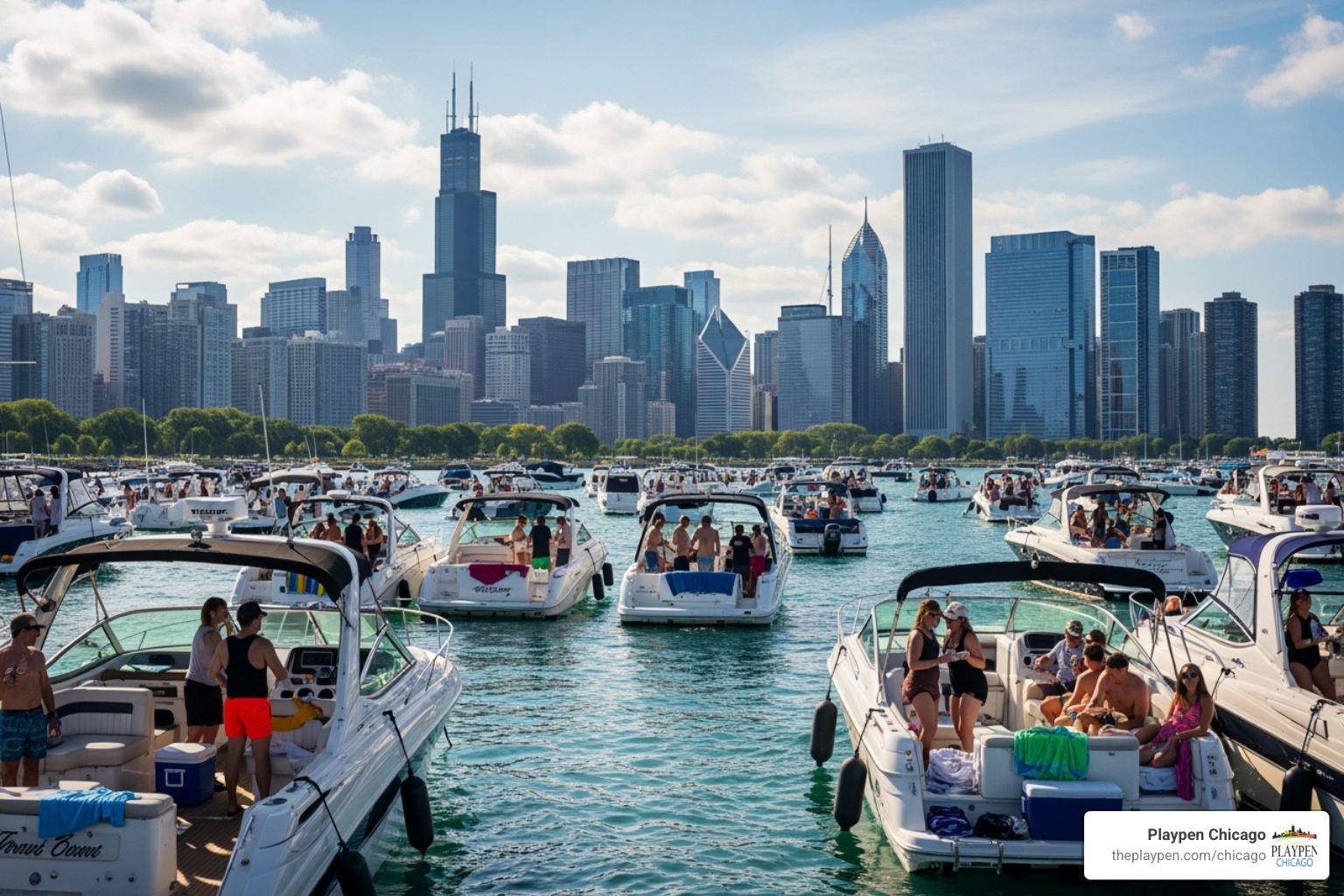
The Playpen is a vibrant social hub, especially during summer weekends. To truly enjoy the camaraderie without compromising safety, we need to master the art of anchoring, understand swimming safety, and observe proper party etiquette. These are crucial chicago playpen safety tips for a seamless experience.
Proper anchoring techniques are paramount in a crowded area like the Playpen. The average depth of the Playpen is about 12 feet. Our rule of thumb for anchor scope is to deploy 5 to 7 times the depth of the water. So, in 12 feet of water, we’re looking at deploying at least 60 to 70 feet of chain or line. We always set our anchor by putting the boat in reverse for at least 30 seconds to ensure it’s firmly dug into the lakebed. An anchor alarm app on our phone is a great tool to monitor our position and ensure we’re not drifting. Using a snubber on our windlass also helps absorb shock and protect our anchor system. For more details, consult our anchoring rules at the Playpen.
When rafting up with other boats, we maintain a safe distance from shorelines and the break wall—at least 100 yards. This buffer is critical in case of power loss or high winds, giving us room to maneuver and prevent collisions.
Swimming in the Playpen is a popular activity, but it comes with its own set of risks. Lake Michigan’s water temperature can be surprisingly cold, even in summer, posing a risk of cold water shock. Always be aware of the signs of drowning: a person facing shore, mouth at water level, head tilted back, and body vertical. We always assign a dedicated “water watcher,” even if lifeguards are present, because drowning can happen silently and quickly. Never leave children unattended near or in the water. For more comprehensive information, explore whether it is safe to jump off a boat, swim, or use a lily pad at the Playpen in Chicago.
While we love our furry friends, we also prioritize pet safety around children and other guests. Even well-behaved pets can become anxious or scared in a crowded boating environment. We train our pets to go to a “safe place” on command and keep them separated from children when direct supervision isn’t possible.
Family on Board? A Guide to Child and Infant Playpen Safety
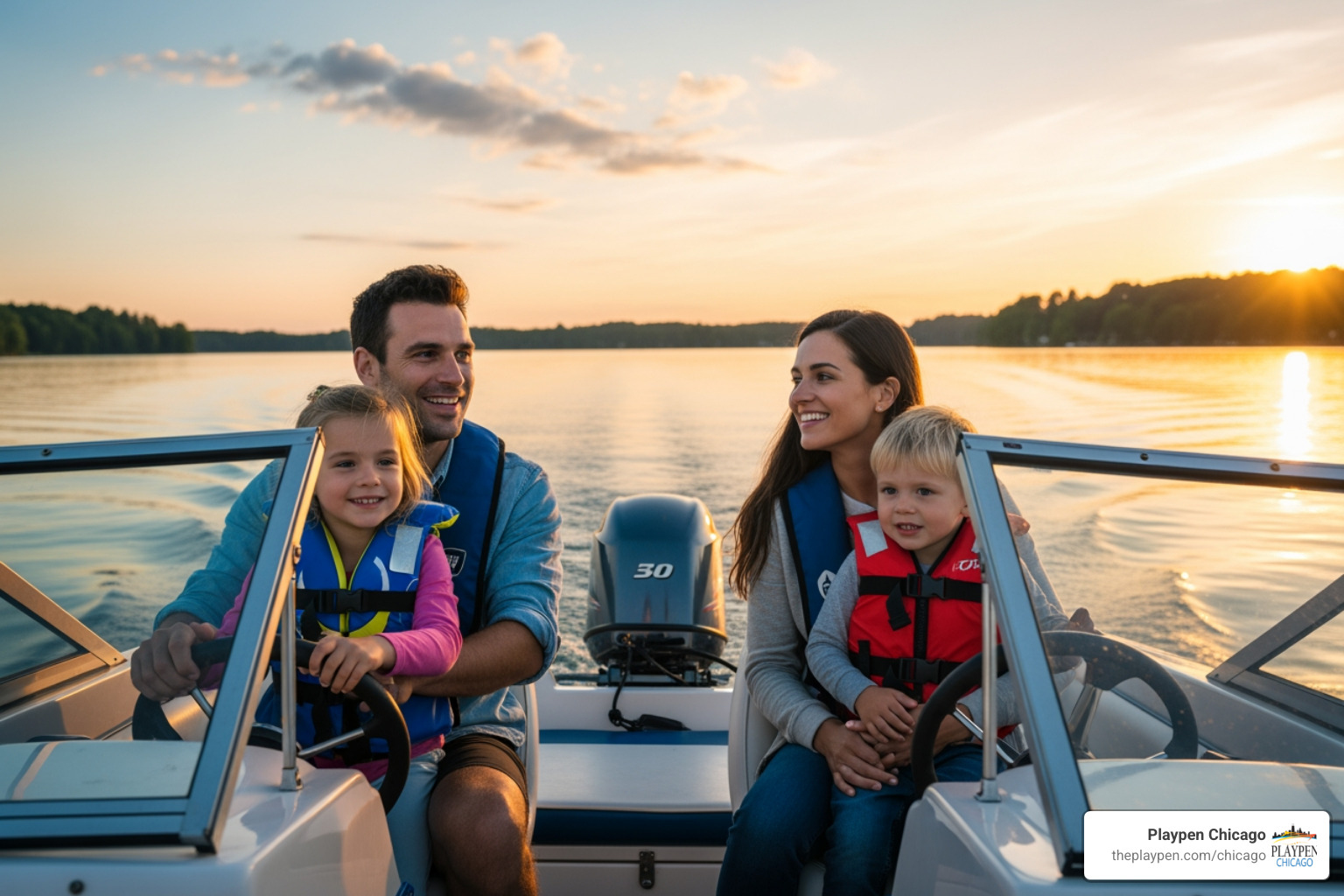
Bringing children and infants aboard adds another layer of responsibility to our chicago playpen safety tips. Their safety is our utmost priority, and with the right precautions, boating can be a wonderful family experience.
One of the most critical rules is the PFD (Personal Flotation Device) requirement. Federal law mandates that all children under the age of 13 MUST wear a lifejacket at all times when boating. For infants, the U.S. Coast Guard warns that they should weigh at least 18 pounds to ensure a PFD fits properly. Infant PFDs should have an extended neck cushion for head support and a strap between the legs to prevent it from riding up. We always double-check the fit to make sure it’s snug and secure.
Sun protection is vital for delicate skin. We create shade using T-tops or biminis, and ensure babies wear wide-brimmed hats and pediatrician-approved sunscreen. Hydration is equally important; we always have plenty of water or formula on hand.
Constant supervision is non-negotiable. We never leave a child or infant unsupervised on a boat. We designate a safe, clear nap space away from hazards and potential falls, ensuring they can rest without interruption. Childproofing the boat is similar to childproofing a home: we secure sharp objects, cleaning supplies, fuel cans, and mess hazards like ropes and fishing lines. We want to protect little hands from anything that could cause harm.
The “Other” Playpen: Using an Infant Playpen Safely
While we talk about the Chicago Playpen as a boating destination, the term “playpen” also refers to a portable enclosure for infants. Many families use these on land, and understanding their safety is just as crucial. These chicago playpen safety tips ensure a safe environment for our little ones, whether at home or visiting friends.
A key difference between a playpen and a crib is that, in general, playpens are not recommended for unsupervised sleep. They are often less durable and secure than cribs, which are designed for long-term, unsupervised sleep. However, for supervised naps or play, a playpen can be a safe option.
When using an infant playpen, we always adhere to the ABCs of safe sleep:
- Alone: Nothing else in the playpen – no bumpers, loose blankets, or stuffed animals.
- Back: Babies should always sleep on their back to prevent Sudden Infant Death Syndrome (SIDS).
- Crib (or Playpen): The safest place for your baby to sleep or play is in their designated safe space. Never co-sleep with your baby.
Suffocation risks are significant. We never add blankets, pillows, or an extra mattress to a playpen. Soft items can increase a baby’s risk of suffocation. The floor pad provided by the manufacturer is specifically designed to fit snugly and provide a firm surface, and any additions can create dangerous gaps or soft spots.
Key chicago playpen safety tips for choosing a new device
When we’re looking to purchase a new infant playpen, we prioritize safety features above all else. These chicago playpen safety tips help us make an informed decision:
- JPMA Certification: We look for the Juvenile Products Manufacturers Association (JPMA) certification on the label. This signifies that the product adheres to safety standards set by the Consumer Product Safety Commission (CPSC).
- Side Height: The sides should be at least 20 inches (51 centimeters) high, measured from the floor of the playpen, to prevent a baby from climbing out.
- Mesh Size: If the playpen has mesh sides, the holes in the mesh should be no larger than ¼ inch (0.6 centimeter). This prevents tiny fingers or buttons on clothing from getting caught. We also ensure the mesh is free of tears, holes, or loose threads.
- Slat Spacing (for wooden playpens): For wooden playpens, the slat spaces should be no more than 2-3/8 inches (5.08 centimeters) in width to prevent a baby’s head from becoming entrapped.
- Top Rail Locks: The top rails should automatically lock when lifted into place, preventing accidental collapse.
- Bassinet Attachments: Bassinet attachments can be a safe sleep option until our baby can roll over or reaches the weight limit, whichever comes first. We ensure all components are used and installed correctly according to manufacturer instructions.
- Change Table Risks: We understand that a change table accessory is not the same as a bassinet attachment and is not a safe place for our baby to sleep. We always remove it before placing our baby in the playpen to prevent entrapment.
Here’s a quick list of safety features to look for:
- JPMA certification
- Sides at least 20 inches high
- Mesh holes no larger than 1/4 inch
- Slat spacing no more than 2-3/8 inches
- Automatic top rail locks
- Firm, snug-fitting floor pad
- Securely attached mesh and rails
- No sharp edges or pinch points
Essential chicago playpen safety tips for maintenance and use
Even the safest playpen needs proper maintenance and usage to remain secure. These chicago playpen safety tips cover ongoing care:
- Proper Assembly: A playpen that is not assembled correctly is not safe. We always follow the manufacturer’s instructions each time we set up our playpen.
- Regular Inspection: We regularly check the playpen for any wear and tear. This includes ensuring the floor pad is firm, as worn-down floor pads can cause suffocation.
- Checking for Tears: We inspect vinyl rail coverings, mesh panels, and the mattress pad for any tears or holes. Tears can lead to a baby biting off small pieces or getting trapped. If we find tears, we repair them immediately with heavy-duty cloth tape or replace the damaged part.
- Firm Floor Pad: The floor pad should always be firm and fit snugly. Never replace the mattress or padding in the playpen, as a non-fitting pad can create dangerous gaps.
- Room Placement: We never place the playpen near windows. Cords on drapes and blinds can strangle a baby. We also keep it away from lamps, patio doors, wall hangings, and electrical outlets.
- Discontinuing Use: We stop using the playpen when our child can easily climb out, typically when they reach a height of 34 inches (86 centimeters) or weigh 30 pounds (14 kilograms). Large stuffed animals or toys should be kept out of the playpen, as a baby could use them to climb out.
- Hand-Me-Down Dangers: We are extremely cautious with hand-me-down playpens, especially older designs. We never use playpens with large diamond-shaped openings, as a baby’s head may get trapped in these holes. Safety standards have evolved, and older models might not meet current requirements.
- No Toys Tied Across the Top: We never tie or string toys from the sides or across the top of the playpen. This creates a strangulation hazard. We also remove mobiles as soon as our baby can push up onto their hands and knees.
Frequently Asked Questions about Playpen Safety
We often get questions about safety, both for the boating Playpen and for infant playpens. Here are some of the most common ones, along with our essential chicago playpen safety tips.
What are the biggest safety risks in the Chicago Playpen boating area?
The biggest safety risks in the Chicago Playpen boating area stem from its popularity and the unique environment of Lake Michigan:
- Congestion: With many boats in a relatively small area, the risk of collisions and improper anchoring increases.
- Improper Anchoring: Boats that aren’t properly anchored can drift, causing damage to other vessels or creating hazards for swimmers. We’ve discussed the importance of anchor scope and setting.
- Intoxicated Operators: Boating under the influence is incredibly dangerous and puts everyone at risk. We strongly advocate for a sober designated operator.
- Cold Water Shock: Lake Michigan’s water can be cold, even in summer. Unexpected immersion can lead to cold water shock, which can quickly incapacitate even strong swimmers.
- Weather Changes: Lake Michigan weather can change rapidly. Sudden storms, high winds, or large waves can turn a pleasant outing into a dangerous situation quickly. Always check forecasts and be prepared to head back.
For more information on staying safe in Lake Michigan, please refer to our guide on How to Stay Safe in Lake Michigan.
Can a baby safely sleep in a playpen on a boat?
While a baby can nap in a playpen on a boat under strict supervision, it’s generally not recommended for unsupervised sleep, especially during movement. The motion of the boat, potential for sudden jolts, and the inherent differences between a playpen and a crib mean we must exercise extreme caution.
If we use a bassinet attachment on a playpen for a supervised nap, we ensure it’s properly installed and our baby hasn’t exceeded the weight or developmental limits (e.g., rolling over). We never use soft bedding or extra mattresses. The key is constant, direct supervision. For longer, unsupervised sleep, a crib on stable ground is always the safest option.
What is the single most important rule for boating in the Playpen?
If we had to pick one single, overarching rule for boating in the Playpen, it would be Responsibility. This encompasses several critical chicago playpen safety tips:
- Responsibility for your vessel: Ensuring it’s seaworthy, properly maintained, and equipped with all necessary safety gear (PFDs, fire extinguishers, etc.).
- Responsibility for your guests: As the captain, we are ultimately responsible for everyone’s safety on board. This means enforcing rules, ensuring sobriety, and communicating safety procedures.
- Responsibility to other boaters: Following navigation rules, maintaining safe distances, and being courteous in a crowded environment.
- Responsibility to the environment: Respecting Lake Michigan and keeping it clean.
Our commitment to responsibility ensures a safe and enjoyable experience for everyone. For more on this, check out our Boat Safety Key.
Conclusion: Make Every Outing a Safe and Memorable One
We believe that the Playpen offers some of the most unforgettable experiences on Lake Michigan. By embracing these comprehensive chicago playpen safety tips, we can ensure that every outing is not only fun but also secure for everyone on board. It all comes down to three key principles: preparation, responsibility, and awareness.
Preparation means checking the weather, having our safety gear ready, and ensuring our vessel is in top condition. Responsibility means making smart choices about who operates the boat, how we anchor, and how we interact with others. Awareness means constantly scanning our surroundings, understanding potential hazards, and knowing how to respond in an emergency.
At Playpen® Chicago, we’re dedicated to fostering a community that prioritizes both exhilarating experiences and unwavering safety. We connect boat owners, charter operators, and social enthusiasts, empowering us all to find and enjoy exclusive yacht outings and events on Lake Michigan. By working together and adhering to these guidelines, we can make every moment in Chicago’s favorite boating spot truly memorable and safe.
Ready to set sail the right way? Explore our complete guide for renters and new yacht owners to learn more about enjoying the Playpen safely and responsibly.