
Lake Michigan Boating Forecast: 5 Essential Safe Tips
Why the Lake Michigan Boating Forecast Matters for Every Trip
Lake Michigan boating forecast information is critical for safe navigation. Here’s how to access it quickly:
Key Marine Forecast Sources:
- National Weather Service (NWS) – Official forecasts by zone at weather.gov/marine
- NOAA Weather Radio – Most current warnings and updates
- National Data Buoy Center – Real-time observations from lake buoys
- NWS Mobile Apps – Zone-specific alerts and graphical forecasts
- Local NWS Offices – Chicago (LOT), Grand Rapids (GRR), Milwaukee (MKX), Green Bay (GRB)
What to Check Before Departing:
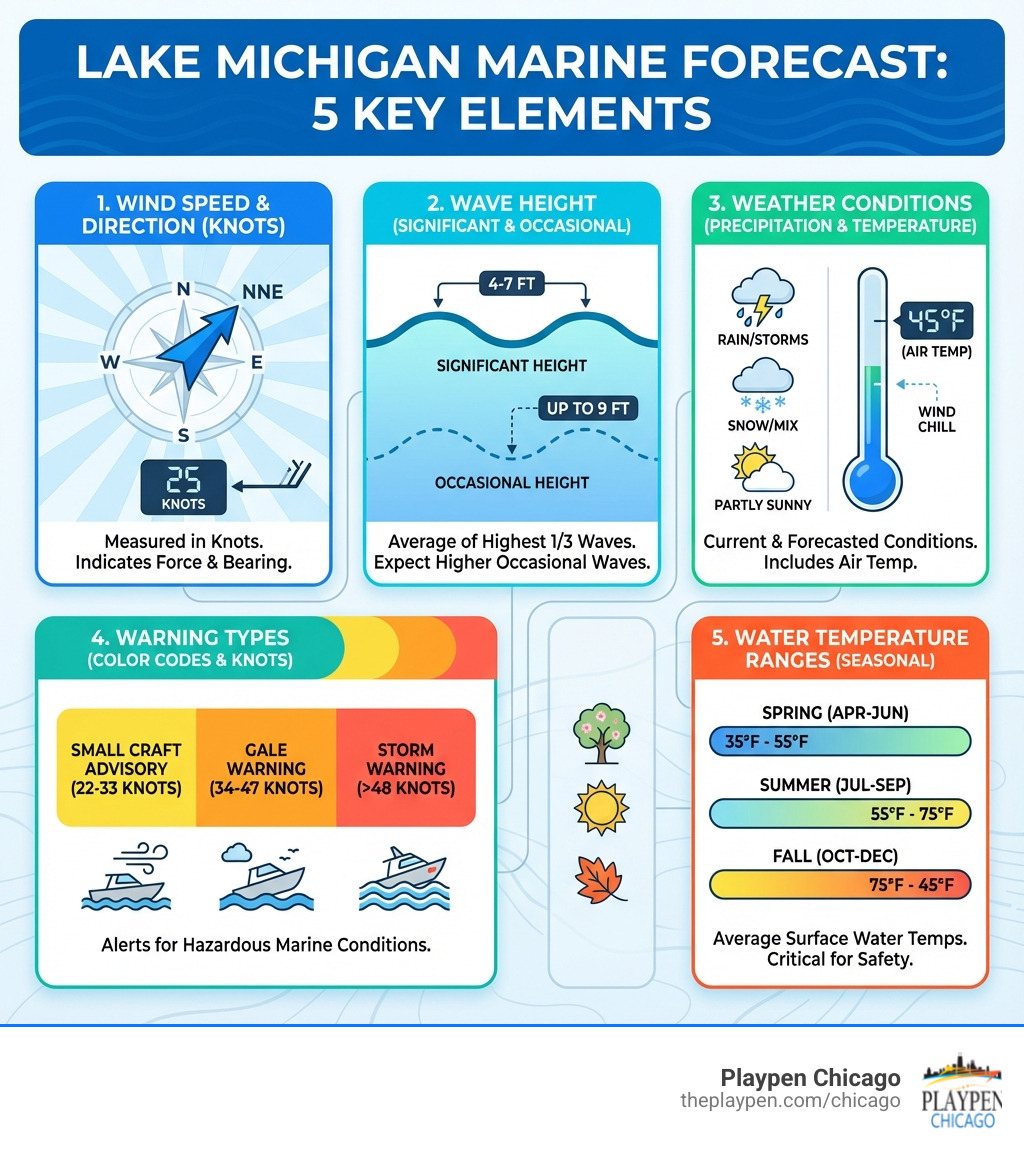
- Wind Speed & Direction (measured in knots)
- Wave Height (significant and occasional heights)
- Active Warnings (Small Craft Advisory, Gale Warning, Storm Warning)
- Precipitation Forecast (rain, snow, thunderstorms)
- Water Temperature (especially important in spring and fall)
Lake Michigan stretches over 300 miles with more than 22,000 square miles of surface area. That makes it beautiful—and powerful.
The lake’s size creates conditions that rival coastal waters. Freshwater forms steeper waves than saltwater. Wind speeds near 30 knots are common. Temperatures can shift dramatically within hours.
These conditions make marine forecasts essential, not optional. A Small Craft Advisory means sustained winds of 22-33 knots or waves over four feet. A Gale Warning indicates winds of 34-47 knots—conditions that can quickly turn dangerous.
Whether you’re heading to the Playpen for a day of socializing or planning a longer cruise up the coast, understanding the forecast keeps you safe. It helps you decide when to go, what to bring, and when to stay docked.
This guide breaks down everything you need to know about Lake Michigan’s marine forecasts. You’ll learn how to read official NWS reports, where to find real-time data, and how to turn forecast information into smart boating decisions.
Decoding the Daily Marine Report
Before we cast off, let’s learn how to read the daily marine report. It’s like deciphering a secret language, but once you know the code, you’ll be a pro at predicting Lake Michigan’s mood. The National Weather Service (NWS) provides incredibly detailed marine forecasts, but they can look a bit intimidating at first glance. Don’t worry, we’ll break it down.
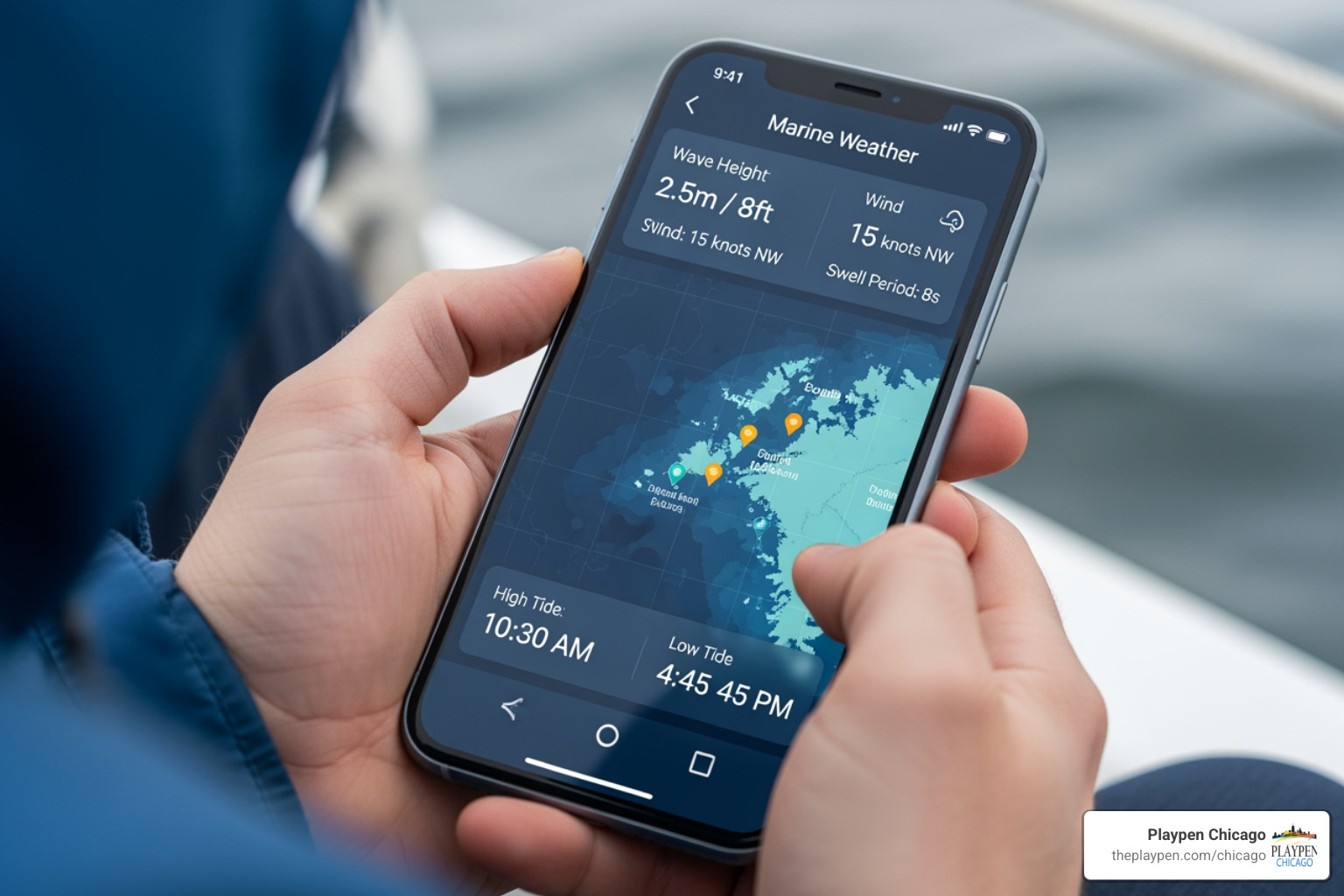
When you pull up a marine forecast, you’ll typically see information on wind speed and direction, wave heights and periods, and any expected precipitation. Crucially, it will also highlight any active warnings or advisories. For instance, a report might say “Northwest winds to 30 kt” or “Waves 5 to 8 ft occasionally to 10 ft.” These are the nuggets of information we need to make informed decisions.
Understanding Marine Warnings and Advisories
The most critical part of any Lake Michigan boating forecast is the warnings and advisories. These are the red flags of the marine world, telling us when it’s time to be extra cautious or, more often, to simply stay ashore. The NWS issues several types of alerts, each with specific criteria:
- Small Craft Advisory: This means sustained surface winds or frequent gusts of 22 to 33 knots, and/or waves greater than four feet are expected. For many recreational boats, especially smaller ones, this is your cue to head back to shore or postpone your trip.
- Gale Warning: This is a serious alert, issued for sustained surface winds or frequent gusts of 34 to 47 knots. When a Gale Warning is in effect, conditions are dangerous for all vessels. For example, our research shows alerts like “Gale Warning in effect from Sunday morning through Sunday evening” are not uncommon on Lake Michigan. This is not the day for a leisurely cruise or a trip to the Playpen.
- Storm Warning: Even more severe than a Gale Warning, a Storm Warning is issued for sustained surface winds or frequent gusts of 48 to 63 knots. These are extremely hazardous conditions.
- Hurricane Force Wind Warning: While rare on Lake Michigan, this warning is for sustained surface winds or frequent gusts of 64 knots or greater.
- Special Marine Warning: These are issued for short-term, severe marine weather events like marine thunderstorm winds or gusts of 34 knots or greater, hail 3/4 inch in diameter or greater, or waterspouts. These can pop up quickly, so always keep an eye on rapidly changing conditions.
- Dense Fog Advisory: Expect widespread or localized fog reducing visibilities to 1 nautical mile or less. Low visibility is a major hazard on the water.
- Dense Smoke Advisory: Similar to fog, this means widespread or localized smoke is reducing visibilities to 1 nautical mile or less.
- Low Water Advisory: If water levels are significantly below average, this can impact safe marine navigation, especially near shorelines, docks, or through channels.
- Heavy Freezing Spray Warning: This is an alert for cold weather boating, indicating accumulation of freezing water droplets at a rate of 2 cm per hour or greater, which can quickly ice up a boat and make conditions very dangerous.
You can always dive deeper into these terms with the NWS Glossary of Marine Terms. Knowing these definitions is the first step to staying safe on Lake Michigan.
Interpreting Wind and Wave Data
Understanding wind and wave data is crucial for assessing comfort and safety on the water.
Wind Speed and Direction:
Wind speeds are always measured in knots (kt) in marine forecasts. One knot is roughly 1.15 miles per hour. So, a “Northwest wind to 30 kt” means winds are blowing from the Northwest at up to about 34.5 mph. Forecasts will often distinguish between “sustained winds” (the average speed over a period) and “gusts” (sudden, brief increases in wind speed). Gusts can be significantly higher than sustained winds and can make for a much choppier, more challenging ride. For example, a forecast might mention “South gales to 35 kt becoming southwest,” indicating a strong, shifting wind pattern.
Wave Heights and Periods:
Wave height is generally reported as significant wave height, which is the average height of the highest one-third of the waves. This gives you a good idea of what the “average big wave” will be like. However, forecasts often include phrases like “Waves 8 to 12 ft occasionally to 16 ft.” This “occasionally to” refers to the average height of the highest 10% of waves you’ll encounter. These occasional rogue waves can be much larger and more powerful, especially on a large body of water like Lake Michigan.
Beyond height, wave period is also important. This is the time between successive wave crests. A long wave period (e.g., 8-10 seconds) means waves are more spread out, creating a rolling motion that can be more comfortable, even with significant height. A short wave period (e.g., 3-5 seconds), however, means waves are close together, resulting in a steep, choppy, and generally more unpleasant and dangerous ride, even if the wave heights aren’t extreme. Freshwater, like Lake Michigan, tends to generate steeper, shorter period waves than saltwater due to its lower density and the lake’s fetch (the distance over which wind blows). This is why a 3-foot wave on Lake Michigan can feel much more jarring than a 3-foot wave on the ocean.
Your Essential Lake Michigan Boating Forecast: What to Expect This Week
Planning ahead is key to a fantastic time on Lake Michigan, whether you’re joining us for an event or just enjoying a private cruise. The NWS provides forecasts that extend several days out, allowing us to anticipate conditions and make smart decisions.
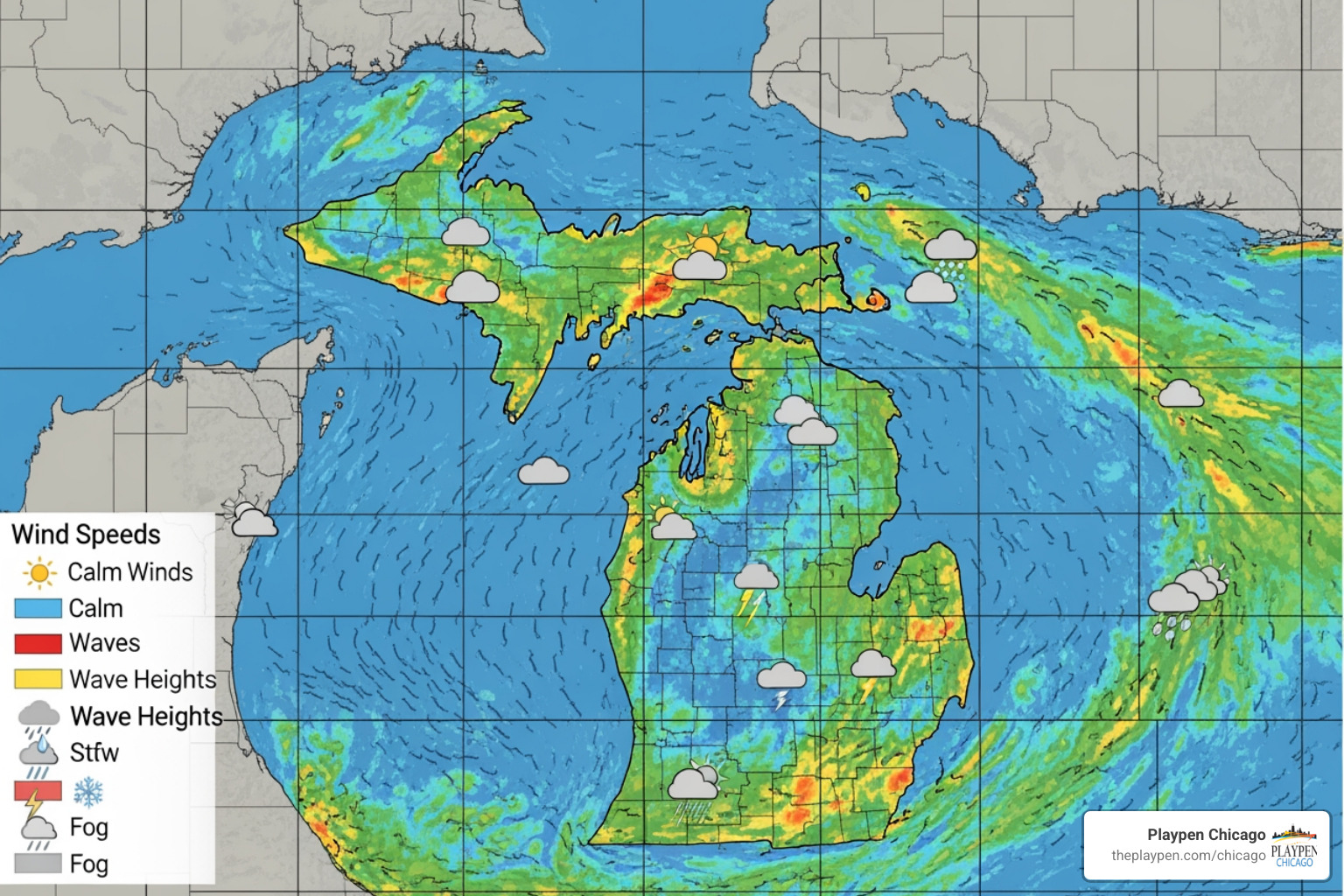
When we look at the Lake Michigan boating forecast, we typically see two main types: Nearshore Forecasts and Open Lakes Forecasts.
- Nearshore Forecasts: These cover the waters within approximately 5 nautical miles (NM) from shore. They are crucial for those staying close to the coastline, perhaps exploring the Chicago shoreline, or heading to the Playpen.
- Open Lakes Forecasts: These are for the expansive waters beyond 5 NM from shore. If you’re planning a longer journey, say from Chicago up to Milwaukee, or even just crossing to the other side of the lake, you’ll need to consult these for a more accurate picture of conditions.
Both types of forecasts give us a snapshot of what to expect, covering wind, waves, and weather patterns. Using the extended forecast helps us spot trends—is a high-pressure system bringing calm, sunny days, or is a low-pressure system brewing up a storm?
Finding the Forecast for Your Zone
Lake Michigan is a big lake, and conditions can vary significantly from north to south, or even from one side to the other. That’s why the NWS divides the lake into specific forecast zones. Each zone has a unique Universal Generic Code (UGC), making it easy to find localized information. For instance, the zone covering Wilmette Harbor to Northerly Island, including the Chicago Playpen area, might be designated as LMZ741.
Forecasts for Lake Michigan are issued by several NWS forecast offices around the lake, including:
- Chicago, IL (WFO LOT)
- Grand Rapids, MI (WFO GRR)
- Milwaukee/Sullivan, WI (WFO MKX)
- Green Bay, WI (WFO GRB)
- Marquette, MI (WFO MQT)
- Gaylord, MI (WFO APX)
This localized approach ensures that the forecast you receive is custom to your specific boating area.
Here are some key NWS Marine Forecast pages for Lake Michigan:
- Marquette MI: https://forecast.weather.gov/product.php?issuedby=MQT&product=NSH&site=mqt
- Gaylord MI: https://forecast.weather.gov/product.php?issuedby=APX&product=NSH&site=apx
- Grand Rapids MI: https://forecast.weather.gov/product.php?issuedby=GRR&product=NSH&site=grr
- Northern Indiana: https://forecast.weather.gov/product.php?issuedby=IWX&product=NSH&site=iwx
- Chicago IL: https://forecast.weather.gov/product.php?issuedby=LOT&product=NSH&site=lot
- Milwaukee WI: https://forecast.weather.gov/product.php?issuedby=MKX&product=NSH&site=mkx
- Green Bay WI: https://forecast.weather.gov/product.php?issuedby=GRB&product=NSH&site=grb
- Open Lakes Forecast: https://forecast.weather.gov/product.php?issuedby=LM&product=GLF&site=mkx
For a comprehensive list of all zones and their text forecasts, check out the Great Lakes Marine Text Forecasts by Zone page.
Planning with the Extended Lake Michigan Boating Forecast
The extended Lake Michigan boating forecast, typically covering 5 to 7 days, is your crystal ball for trip planning. It allows us to analyze upcoming weather patterns and make crucial go/no-go decisions.
For example, a forecast might indicate:
- “Monday Night: South gales to 35 kt becoming southwest. Chance of snow overnight. Waves 8 to 12 ft occasionally to 16 ft building to 12 to 16 ft occasionally to 21 ft.”
- “Wednesday: West gales to 40 kt becoming northwest. Rain showers likely with a chance of snow showers. Waves 12 to 16 ft occasionally to 21 ft.”
These are clearly not ideal boating conditions! A forecast showing “Monday: Northwest winds 10 to 20 kt… Waves 4 to 6 ft” might be manageable for larger, more stable vessels, but still warrants caution.
By looking at the bigger picture, we can:
- Avoid hazardous conditions: If gales are predicted for Monday night through Wednesday, we know to reschedule our Lake Michigan adventure.
- Prepare for changing weather: If winds are expected to shift from “Northwest winds 10 to 20 kt diminishing to 10 to 15 kt” on Monday to stronger winds later in the week, we can plan shorter trips or stay closer to shore.
- Pack appropriately: Knowing if “Rain showers likely with a chance of snow showers” is coming means we’ll pack extra layers and foul-weather gear.
The lake’s temperament can change quickly. Even with a favorable extended forecast, always check the daily updates before and during your trip.
Top Resources for Real-Time Lake Michigan Data
Forecasts are fantastic for planning, but what about the here and now? That’s where real-time data comes in. Think of it this way: a forecast is what’s expected, but real-time observations tell you what’s actually happening. On a dynamic body of water like Lake Michigan, checking live data right before you head out is non-negotiable.
These observations, often from weather buoys scattered across the lake, provide current conditions that can confirm or adjust your understanding of the forecast.
Where to Find the Live Lake Michigan Boating Forecast
The National Data Buoy Center (NDBC) is our best friend for real-time observations. NOAA operates a network of buoys and coastal stations that collect vital weather and oceanographic data. These buoys are like little weather stations floating on the lake, giving us immediate updates on wind, waves, and even water temperature.
For Lake Michigan, several key buoys provide invaluable data:
- North Buoy: (at 45.344, -86.411)
- Mid-Lake Buoy: (at 44.055, -87.050)
- South Buoy: (at 42.674, -87.026)
- Wilmette Buoy: (at 42.135, -87.655) – Crucial for Chicago area boaters.
- Waukegan Buoy: (at 42.368, -87.795)
- Chicago Buoy: (at 41.892, -87.563) – Right in the heart of Chicago’s boating scene.
- Michigan City Buoy: (at 41.755, -86.968)
When you access a buoy page, you’ll see current wind speed and direction, significant wave height, dominant wave period, and water temperature. The water temperature is especially important in the spring and fall when cold water can pose a hypothermia risk, even on sunny days.
You can directly access these observations and associated forecasts via the Lake Michigan Buoy Observations and Forecasts page.
Monitoring Water Levels and Live Radar
Beyond wind and waves, two other real-time data points are crucial for Lake Michigan boaters: water levels and precipitation.
Great Lakes Water Levels: Water levels can fluctuate due to seasonal changes, precipitation, and even strong winds (known as seiches). High water levels can reduce clearance under bridges or flood low-lying areas, while low levels can expose shoals, make docking difficult, or restrict access to certain harbors. Always check water levels, especially if you’re exploring new areas or navigating shallower channels. NOAA’s Tides & Currents provides excellent data for this. We can find real-time data through Real-Time Water Levels or more general Great Lakes Water Level Data.
Live Radar: Nothing ruins a perfect day on the lake faster than an unexpected downpour or, worse, a pop-up thunderstorm. NEXRAD Doppler Radar provides real-time tracking of precipitation, allowing us to see exactly where rain, snow, or storms are and where they’re heading. This is invaluable for avoiding bad weather or seeking shelter if a storm is approaching. The NEXRAD Doppler RADAR is an excellent resource for this. It’s like having eyes in the sky, showing you what’s coming before it arrives.
Boating Safety: Turning Forecasts into Action
Knowing the Lake Michigan boating forecast is only half the battle. The other half is using that knowledge to ensure a safe and enjoyable trip. At Playpen Chicago, we believe that informed boaters are safe boaters.
Before you even think about leaving the dock, we recommend a thorough pre-departure checklist:
- Check the Forecast (Again!): Look at the latest NWS marine forecast, buoy observations, and radar. Are there any new warnings?
- Inspect Your Boat: Is all safety equipment on board and in working order? (Life jackets, fire extinguisher, flares, first-aid kit, horn/whistle, anchor, bilge pump).
- Fuel and Fluids: Enough fuel for your trip plus a reserve? Engine oil, coolant, and other fluids at proper levels?
- Communication: Fully charged cell phone in a waterproof bag, and a working VHF radio.
- Float Plan: Tell someone on shore where you’re going, who’s with you, and when you expect to return. This is crucial if you run into trouble.
- Dress for Success: Layered clothing is always best on Lake Michigan. Even on a warm day, a sudden wind shift can make it chilly.
- Hydration & Snacks: Bring plenty of water and food.
Safety Tips Based on the Lake Michigan Boating Forecast
Different forecasts call for different levels of caution:
- During a Small Craft Advisory: For smaller vessels (under 20 feet), this is usually a stay-at-home day. For larger boats, exercise extreme caution. Conditions will be rough, and waves over 4 feet can be uncomfortable and potentially dangerous. If you do go out, stay close to shore and be prepared to head in at a moment’s notice.
- During a Gale Warning: Simply put: do not go out. Sustained winds of 34-47 knots and accompanying large waves are dangerous for all but the largest, most seaworthy vessels. It’s just not worth the risk. The lake is powerful, and it demands respect.
- The “1-foot rule” for small boats: A general rule of thumb for smaller boats (under 20 feet) is to consider your boat’s length and freeboard. If waves are consistently over 1-2 feet, smaller boats can quickly become overwhelmed. A 3-foot wave on Lake Michigan can feel like a mountain in a small craft due to its steepness and short period. We encourage all our members to understand their boat’s limitations and err on the side of caution.
Always remember that Lake Michigan’s power is immense. The stunning beauty can quickly turn into a formidable challenge if you’re not prepared.
“Know Before You Go” Checklist
To help you make smart decisions, here’s a quick comparison of conditions and what they mean for your boating plans:
| Condition Category | Ideal Boating Conditions | Hazardous Boating Conditions |
|---|---|---|
| Wind Speed | Light breeze (5-10 kt) | Strong winds (25+ kt), Gale Warning (34-47 kt) |
| Wind Gusts | Minimal | Frequent, strong gusts (e.g., up to 40 kt) |
| Wave Height | Calm (1-2 ft) | Large waves (8-12 ft, occasionally to 16 ft), steep/choppy |
| Wave Period | Long, rolling | Short, steep, jarring |
| Warnings/Advisories | None | Small Craft Advisory, Gale/Storm Warning, Special Marine Warning |
| Visibility | Clear (10+ NM) | Dense Fog/Smoke Advisory (1 NM or less) |
| Precipitation | None | Heavy rain, snow, thunderstorms likely |
| Water Temp | Comfortable | Cold (risk of hypothermia) |
Here are some actionable steps for your “Know Before You Go” routine:
- Check Multiple Sources: Don’t just rely on one forecast. Cross-reference NWS text forecasts, graphical forecasts, and real-time buoy data.
- Inform Passengers: Share the forecast with everyone on board so they know what to expect and can dress appropriately.
- Continuously Monitor: Once on the water, keep an eye on the sky and listen to weather radio or check apps for updates. Conditions can change rapidly.
- Download the USCG App: The U.S. Coast Guard Mobile App is a fantastic tool for boating safety resources, including local weather.
Conclusion: Sail Smart and Join the Community
Understanding the Lake Michigan boating forecast is not just a good idea—it’s essential for safe and enjoyable adventures on this magnificent body of water. We’ve learned how to decode marine reports, interpret critical wind and wave data, find localized zone forecasts, and access real-time observations from buoys and radar. We’ve also highlighted the severe implications of warnings like Small Craft Advisories and Gale Warnings, emphasizing that respecting the lake’s power is paramount.
The joy of boating on Lake Michigan is unparalleled, from the vibrant energy of the Chicago Playpen to the serene beauty of a sunset cruise. By sailing smart and making informed decisions based on accurate forecasts, we ensure that every moment on the water is memorable for all the right reasons.
At Playpen Chicago, we’re all about fostering a vibrant boating culture and connecting enthusiasts. We invite you to join our community, where you can connect with fellow boaters, find last-minute seats on boats with WaveMates™, and find exclusive on-water events. Whether you’re a seasoned captain or just dipping your toes into the boating lifestyle, Playpen Chicago is your hub for unforgettable experiences.
Ready to connect and explore the best of Lake Michigan? Get More info about joining Chicago’s premier boating community today!