
Ready to Helm? Becoming a USCG Licensed Captain in the Windy City
Your Gateway to Captaining on Lake Michigan
How to become a charter captain in chicago starts with earning your U.S. Coast Guard (USCG) Merchant Mariner Credential—commonly called a captain’s license. This federal credential legally authorizes you to operate vessels carrying passengers for hire on Lake Michigan, the Chicago River, and other Great Lakes waters.
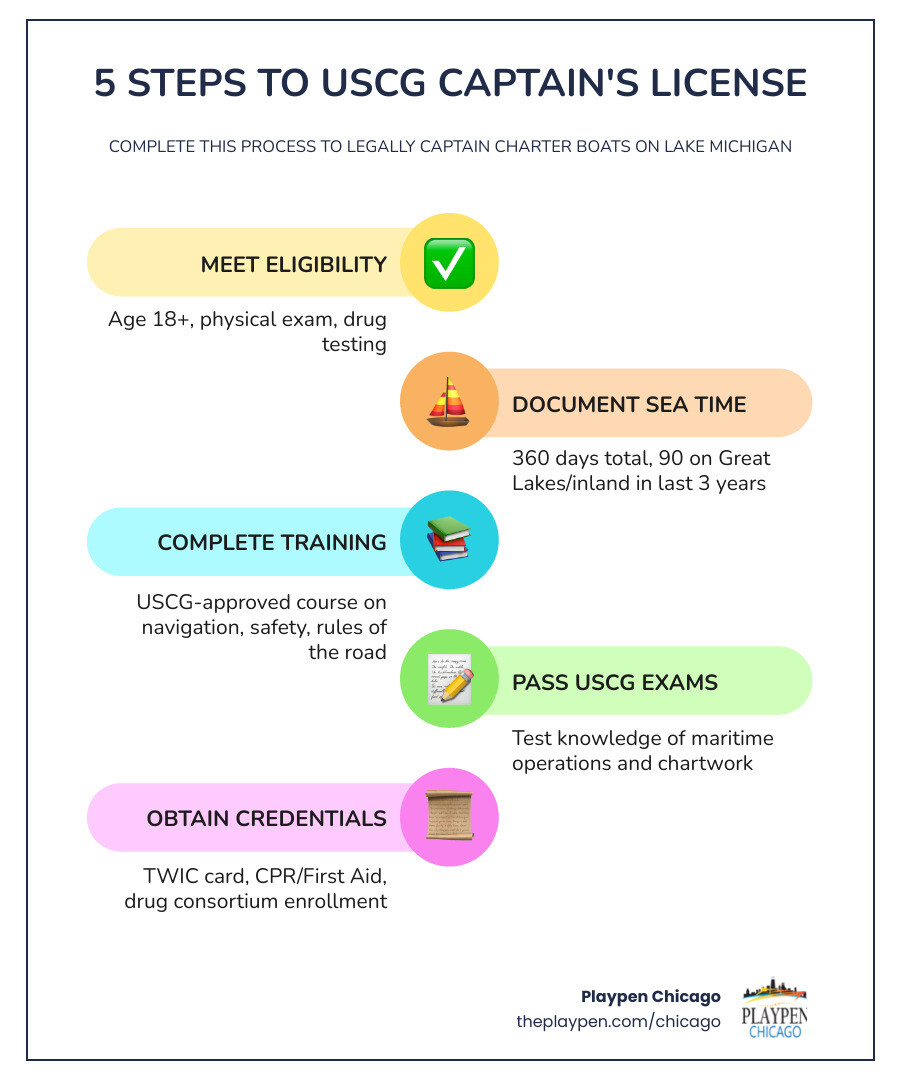
Here’s the essential path:
- Meet basic eligibility – Be at least 18 years old, pass a physical exam, and complete drug testing
- Document 360 days of sea time – With 90 of those days on Great Lakes or Inland waters within the last three years
- Complete a USCG-approved training course – Covering navigation, safety, rules of the road, and chartwork
- Pass USCG exams – Demonstrating your knowledge of maritime operations
- Obtain required credentials – Including a TWIC card, CPR/First Aid certification, and enrollment in a drug testing consortium
Most aspiring captains pursue the OUPV (Operator of Uninspected Passenger Vessels) license, also called a “6-pack,” which allows you to carry up to six paying passengers on vessels under 100 gross tons. For larger operations carrying seven or more passengers, you’ll need a Master license.
Chicago’s charter market is thriving. From architecture tours and fishing expeditions to private events at the famous Playpen anchorage, licensed captains earn between $75-$120 per hour, with experienced professionals commanding significantly more. The mean annual salary for captains nationwide was approximately $98,000 in 2021, with top earners exceeding $160,000.
The entire process typically takes three to six months, depending on how quickly you accumulate sea time and complete coursework. Total costs range from $1,500 to $2,500, including training, exams, medical requirements, and government fees.
Your license remains valid for five years, after which you’ll need to renew with updated medical documentation and proof of continued sea service or refresher training.
I’m Heidi Auvenshine, Partnership and Marketing Director for Playpen Chicago, where I’ve worked extensively with USCG licensed captains navigating Chicago’s waterfront charter market. My experience connecting boat owners, charter guests, and professional captains gives me unique insight into how to become a charter captain in chicago and build a successful career on Lake Michigan’s premier social boating scene.
Understanding the Path: How to Become a Charter Captain in Chicago

If you have ever spent a Saturday afternoon in the Playpen or watched the fireworks from a yacht at Navy Pier, you’ve likely thought, “I could get used to this.” But turning that passion for the water into a paycheck requires more than just a steady hand on the wheel. In the eyes of the U.S. Coast Guard, as soon as you accept any form of compensation—whether it’s cash, a trade of services, or even a nice dinner—you are operating a “passenger-for-hire” vessel.
Operating in Chicago is unique because we sit at the intersection of Inland and Great Lakes waters. This affects the “scope” of your license. While an Inland license allows you to operate in harbors and rivers, a Great Lakes endorsement is essential for anyone looking to run serious charters out of 31st Street Harbor or DuSable.
The career benefits are hard to beat. According to the Bureau of Labor Statistics, there were about 33,500 captains in the U.S. in 2021, with a mean annual salary of $98,000. In a high-demand market like Chicago, where the season is condensed and the social scene is electric, top-tier captains can make a significant portion of that in just a few months. Beyond the money, you’re looking at a “cubicle-free” office with the best views of the Sears (Willis) Tower. Check out our guide on being a Yacht Captain for Hire to see what the lifestyle is really like.
Choosing the Right License Type
The first fork in the road is deciding between an OUPV and a Master license.
- OUPV (6-Pack): This is the entry-level commercial license. It allows you to take up to six passengers on an uninspected vessel. If you’re planning on running a small fishing charter or a private family tour on a 40-foot cruiser, this is likely all you need.
- Master License: If you want to work on “inspected” vessels (those that have a USCG Certificate of Inspection) or carry more than six passengers, you need a Master license. This is common for water taxis, large architecture tour boats, and big dinner cruise ships.
Your license will also have a tonnage rating (25, 50, or 100 tons). This isn’t about how much the boat weighs on a scale, but its internal volume. Most recreational boats in Chicago fall under the 25 or 50-ton bracket. You can dive deeper into the nuances in our article on Captain Licensing: USCG License Types.
Why Chicago is a Premier Market for Captains
Chicago isn’t just a boating city; it’s the boating city of the Midwest. The demand for skilled captains is driven by a massive tourism industry and a local culture that lives for the lake.
Between sportfishing for salmon and trout, architecture tours on the river, and the legendary “raft-ups” in the Playpen, there is never a shortage of work. By joining The Playpen Chicago Captain Network: Your Path to Earning Income on Lake Michigan as a USCG Licensed Captain, you gain access to a community that helps you turn your credentials into a thriving business.
Core Requirements and the USCG Application Process
Getting your license isn’t just about passing a test; it’s about proving you are a reliable professional. The USCG has strict standards to ensure the safety of the millions of people who take to the water every year.
| Requirement | OUPV (6-Pack) | Master (Inland/GL) |
|---|---|---|
| Minimum Age | 18 Years Old | 19 Years Old |
| Sea Time | 360 Days | 360 – 720 Days (Based on Route) |
| Citizenship | U.S. Citizen or Resident Alien | Must be a U.S. Citizen |
| Physical Exam | Required (CG-719K) | Required (CG-719K) |
| Drug Test | Required (DOT 5-Panel) | Required (DOT 5-Panel) |
One of the first things you should do is apply for your TWIC (Transportation Worker Identification Credential). This is a biometric security clearance from the TSA. You can’t get your Merchant Mariner Credential without it. You can find a full breakdown of the paperwork in our USCG License Requirements guide.
Medical Fitness and Safety Certifications
You’ll need to prove you’re physically up to the task. This involves a USCG-approved physical using Form CG-719K. A doctor will check your vision, hearing, and general health to ensure you can safely lead a crew and passengers.
Perhaps more importantly, you must be drug-free. The USCG has a zero-tolerance policy for marijuana, even though it is legal in Illinois. You must pass a DOT 5-panel drug test and, in most cases, join a drug screening consortium like apcadrugtesting.com to remain compliant. Finally, you’ll need valid CPR and First Aid certifications from a USCG-approved provider.
Documenting Sea Time for Chicago’s Inland Waters
Sea time is the most common hurdle for new captains. A “day” of sea time is defined as at least four hours underway. For an OUPV license, you need 360 days of experience since the age of 16.
For Chicago captains, the “recency” and “location” requirements are key:
- 90 days must be on Great Lakes or Inland waters.
- 90 days must have occurred within the last three years.
If you’ve spent years on your own boat or helping friends move their yachts between harbors, that time counts! You’ll use Form CG-719S to self-certify time on your own vessel or have boat owners sign off on time spent on theirs. If you have military experience, if your service began after March 2014 A 50-ton license requires 180 days on ships over 26 gross tons, which can significantly fast-track your application.
Approved Courses and Training to Become a Charter Captain in Chicago
Unless you want to take the grueling exams directly at a USCG Regional Exam Center (REC), we highly recommend taking a USCG-approved course. These schools are authorized to give their own exams, and if you pass their test, the Coast Guard accepts that certificate in lieu of their own testing.
You can find relevant forms and a list of approved providers on the National Maritime Center website. These courses cover four main modules:
- Rules of the Road: The “traffic laws” of the sea.
- Navigation General: Understanding tides, currents, and weather.
- Chart Plotting: The art of finding your way using paper charts and tools.
- Deck General: Safety, firefighting, and boat handling.
Local and Online Training Options
Chicagoans have several great options for training. Schools like Sea School and Chicago Yacht Academy offer in-person classes where you can learn hands-on from experienced local mariners. If you have a busy schedule, Mariners Learning System offers comprehensive online courses that allow you to study at your own pace. For more resources on local schools, visit our USCG Captains category.
Essential Endorsements for the Great Lakes
Once you have your base license, you might want to add “endorsements” to make yourself more employable:
- Assistance Towing: If you want to work for a company like Sea Tow or TowBoatUS, you need this. It requires a short 20-question exam.
- Auxiliary Sail: Necessary if you plan to operate a sailing charter with more than six passengers on an inspected vessel.
- Great Lakes Endorsement: Essential for Chicago, requiring 90 days of sea time specifically on Great Lakes waters.
Knowing these details helps when you’re looking How to Find and Hire a Captain for Your Boat Charter at the Playpen in Chicago on Lake Michigan, as it ensures the captain has the right “badges” for the job.
Navigating Local Chicago Regulations and Permits
Having your USCG license is the biggest step, but if you want to run a business in Chicago, you have to play by the city and state rules too.
The City of Chicago requires a Commercial Passenger Vessel (CPV) license for any boat carrying passengers for hire. This license is issued by the Department of Business Affairs and Consumer Protection (BACP). If your boat carries more than 20 passengers, the fee is $350; for fewer than 20, it’s a modest $75.
Additionally, the Illinois Department of Natural Resources (IDNR) requires a Passenger Boat License for the vessel itself. You can find more about these specific local requirements in our guide to Charter Permit Requirements.
Passenger Limits and Vessel Inspections
In Chicago, the “magic number” is six.
- Uninspected Vessels: These can carry up to six passengers. The captain must have at least an OUPV license.
- Inspected Vessels: These carry seven or more passengers. These boats must undergo rigorous annual USCG inspections and possess a Certificate of Inspection (COI). The captain must have a Master license.
We go into great detail on these distinctions in our article on USCG Charter Regulations: Bareboat & Passenger Limits.
Insurance and Business Compliance
You wouldn’t drive a car in Chicago without insurance, and you certainly shouldn’t helm a charter boat without it. Most Chicago harbors and commercial permits require $1,000,000 in General Commercial Liability Insurance.
Importantly, you must name the Chicago Park District and the harbor management as “Additionally Insured.” Understanding the difference between a time charter (where you provide the boat and the captain) and a bareboat charter (where the guest “rents” the boat and hires the captain separately) is crucial for insurance and legal compliance. For more on this, see Understanding Passenger & Crew Limits on Bareboat Charters in Playpen Chicago.
Launching Your Career: How to Become a Charter Captain in Chicago
Once the gold-stamped credential arrives in your mailbox, the real fun begins. But how do you actually find work?
The salary outlook for Chicago captains is strong. While the national mean is around $98,000, many Chicago captains supplement their income by listing their services on platforms like Playpen Chicago. By creating a profile, you can connect directly with boat owners who need a professional for their private outings or charter operators looking for seasonal help.
Thriving Charter Niches in the Windy City
To maximize your earnings, consider specializing in one of these high-demand Chicago niches:
- Sportfishing: Lake Michigan is world-famous for salmon and trout.
- Architecture & History Tours: The Chicago River is a goldmine for educational charters.
- Social Charters: Bachelorette parties, birthdays, and “Playpen days” are the bread and butter of the summer season.
- Fireworks Cruises: Navy Pier fireworks on Wednesday and Saturday nights are always a sell-out.
Maintaining Your Professional Standing
Your captain’s license is valid for five years. Don’t let it lapse! You have a one-year grace period after expiration, but you cannot work during that time. To renew, you’ll need to show either 360 days of sea service during the past five years or take a renewal exam/course.
Staying active in the community and keeping your medical and drug testing records up to date is part of the job. If you’re ever unsure of the next step, the National Maritime Center’s training and assessment page is the place to start here.
Frequently Asked Questions about Chicago Captaining
How much does it cost to get a captain’s license in Chicago?
Expect to invest between $1,500 and $2,500. This covers your USCG-approved course ($800–$1,200), TWIC card ($125), physical exam and drug test ($200–$400), and USCG application fees ($145–$255).
How long does the licensing process take from start to finish?
If you already have your sea time documented, you can complete the course and exams in a few weeks. However, the USCG background check and application review typically takes 4 to 8 weeks. Total time from deciding to “go for it” to having the license in hand is usually 3 to 6 months.
What are the specific passenger limits for Chicago charter boats?
For uninspected vessels (OUPV license), the limit is 6 passengers. For bareboat charters (where the guest “owns” the boat for the day), the limit is 12 passengers plus the charterer. Anything over these limits requires an inspected vessel and a Master license.
Conclusion
Becoming a USCG licensed captain in Chicago is more than just a career move—it’s an entry into an elite community of mariners who call Lake Michigan their home. Whether you want to run high-energy parties in the Playpen, lead peaceful sunrise fishing trips, or captain a luxury yacht for private clients, the path is clear.
At Playpen Chicago, we are here to support you every step of the way. Our platform is the perfect place to list your services, network with boat owners, and find your footing in the local industry. Ready to turn your love for the water into a professional reality? Join The Playpen Chicago Captain Network today and let’s get you out on the water!