
USCG Charter: Bareboat & Passenger Limits 2025 Safe
Why USCG Charter Regulations Matter for Your Chicago Boating Experience
USCG charter regulations, bareboat & passenger limits are the legal framework that determines how many guests you can bring aboard, who can captain the vessel, and what type of charter you’re actually operating. Understanding these rules isn’t just about avoiding fines—it’s about ensuring everyone’s safety on Lake Michigan.
Quick Answer: Key USCG Charter Rules You Need to Know
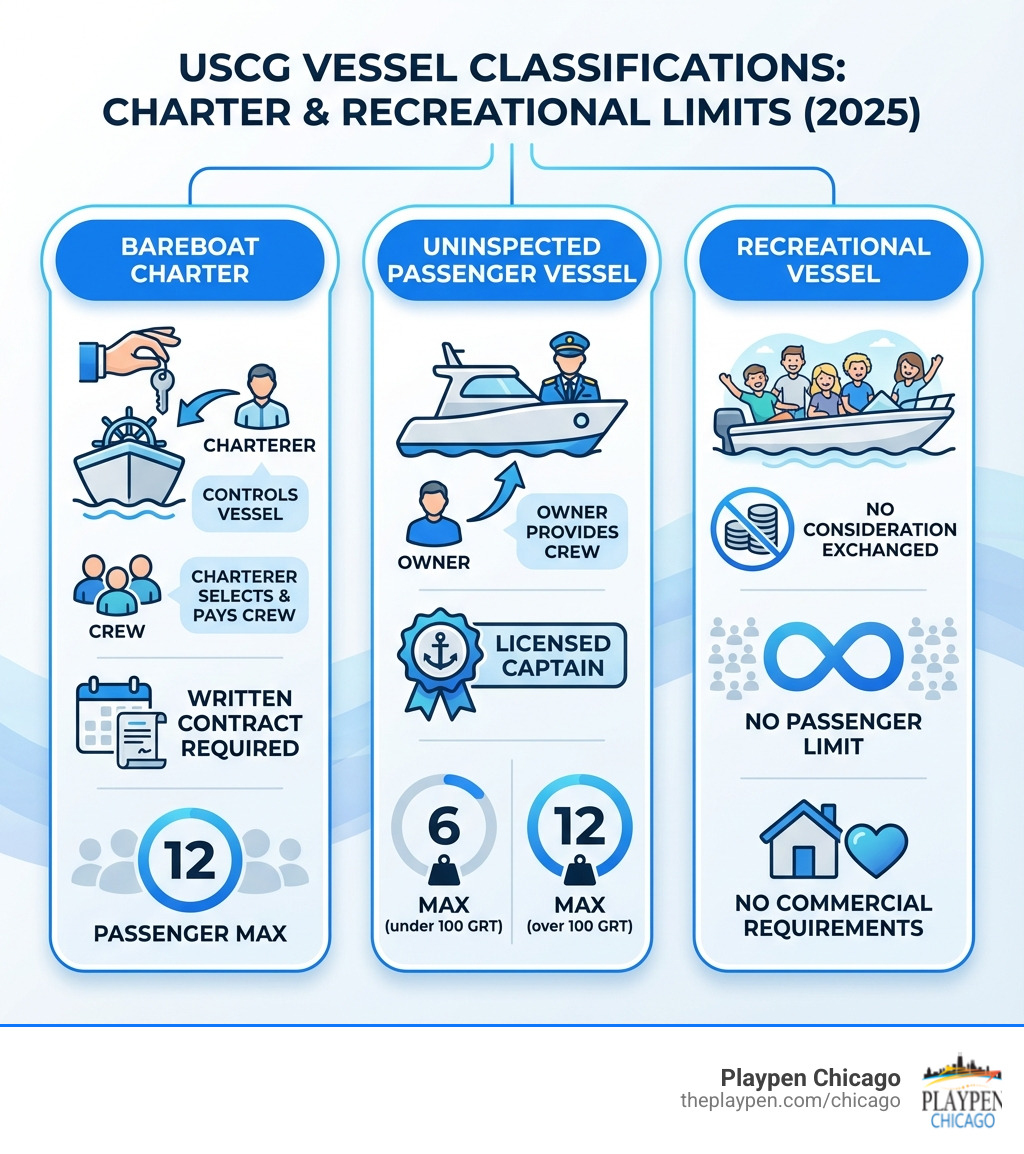
- Bareboat Charter (no crew provided): Maximum 12 passengers, requires written contract, charterer selects and pays crew
- Uninspected Passenger Vessel under 100 GRT: Maximum 6 passengers for hire
- Uninspected Passenger Vessel over 100 GRT: Maximum 12 passengers for hire
- Recreational Vessel (no consideration): No passenger limit
- Owner cannot be on board during a valid bareboat charter
- Violations carry civil penalties up to $42,750 per day
Ever wonder why so many boats on Lake Michigan list a maximum guest capacity of 12? Or why some luxury yacht listings specifically mention “bareboat charter”? It’s not arbitrary—it’s federal law.
The U.S. Coast Guard draws a critical line between a bareboat charter (where you rent the vessel and control its operation) and a passenger vessel (where the owner provides the crew). Cross that line, even accidentally, and your celebration on the water could be interrupted by a Coast Guard inspection or, worse, a tow back to the dock.
Chicago’s Playpen becomes especially tricky during peak season. What seems like a simple boat rental with friends can quickly become a regulatory issue if you’re not clear on who’s considered a “passenger,” what counts as “consideration,” and when your vessel needs a Certificate of Inspection.
The stakes are high. In the past, bareboat charters were sometimes used as a loophole to avoid USCG inspections while carrying between 6 and 12 passengers. But after clarifications in the Passenger Vessel Safety Act of 1993, the Coast Guard closed many of these gaps. Today, failure to comply with federal passenger vessel requirements can result in civil penalties, vessel seizure, and even criminal liability if someone gets hurt.
Decoding Vessel Classifications: Bareboat vs. Passenger Vessel
When we talk about chartering a boat on Lake Michigan, understanding the fundamental difference between a bareboat charter and a passenger vessel is crucial. It’s not just semantics; it’s a distinction that impacts everything from safety requirements to who can legally operate the vessel.
At its core, a bareboat charter is like renting a car – you get the vehicle, and you’re responsible for driving it. The boat owner rents out their vessel without providing a crew. The individual or group leasing the boat, known as the charterer, takes on full responsibility for operating it, including managing the crew (if any) and all aspects of the boat’s operation during the rental period. This means the charterer has complete operational control.
In contrast, a passenger vessel is a boat where the owner (or their agent) provides or specifies the crew. Here, the owner retains a degree of operational control, and the vessel is typically carrying “passengers for hire.” This classification triggers a whole different set of USCG charter regulations, bareboat & passenger limits, often requiring a licensed captain and, for larger capacities, a Certificate of Inspection (COI). The distinction is about who holds the reins – if the owner is still steering (literally or figuratively), it’s likely a passenger vessel.
What is a Valid Bareboat Charter?
The U.S. Coast Guard has a very specific definition for a bareboat charter, and we need to adhere to it strictly. According to the USCG, a bareboat charter occurs when a boat owner rents out their vessel without providing a crew. The charterer, the person leasing the boat, is fully responsible for its operation, including selecting and managing the crew.
For an agreement to be recognized as a valid bareboat charter (sometimes referred to as a “demise charter” in legal terms), several key elements must be met:
- Complete Control by the Charterer: The charterer must have full possession and control of the vessel. This means they must be able to select and hire the crew and have the final say in how the boat is operated. The owner cannot dictate the boat’s operations.
- Written Contract: A clear, legally binding written contract is required, outlining the terms of the bareboat charter. This contract solidifies the transfer of operational control to the charterer for the duration of the agreement.
- Owner Non-Interference: Critically, the boat owner cannot be on board during the charter or dictate how the boat is run. In fact, the owner of the vessel may not even be the vessel’s master or part of the crew. Any owner involvement in the operation can invalidate the bareboat status and reclassify the vessel as a passenger vessel.
This clear guidance from the USCG, especially following the Passenger Vessel Safety Act of 1993, helps prevent the misuse of bareboat charters to sidestep safety regulations. For those interested in the legislative details, the Guidance on the Passenger Vessel Safety Act of 1993 provides comprehensive insights.
The Charterer’s Responsibilities
When you enter into a bareboat charter, you’re not just renting a boat; you’re stepping into the shoes of the owner for that period. This means taking on significant responsibilities that ensure a safe and compliant experience on Lake Michigan.
As the charterer, you are responsible for:
- Safe Navigation: You are ultimately responsible for the safe navigation of the vessel. This includes understanding local rules, weather conditions, and ensuring the vessel is operated safely.
- Providing Food and Fuel: Unlike a crewed charter where provisions might be included, in a bareboat charter, you must arrange for all food, beverages, and fuel for your trip.
- Paying All Expenses: All operational expenses, from dockage fees in the Chicago harbors to waste disposal, fall to the charterer.
- Obtaining Insurance: While the owner will have their own insurance, it is prudent for the charterer to understand their liabilities and potentially secure additional coverage, especially for “passengers for hire” liability if applicable.
- On-Charter and Off-Charter Surveys: To protect both parties, it’s a best practice to conduct “on-charter” and “off-charter” surveys. An “on-charter” survey documents the vessel’s condition when it’s handed over to you, and an “off-charter” survey confirms it’s returned in the same condition, accounting for normal wear and tear.
These responsibilities highlight the level of control and accountability a bareboat charter demands. It’s a fantastic way to enjoy Lake Michigan with freedom, but it requires thorough preparation.
Passenger Vessels: When Your Charter Isn’t a Bareboat
Sometimes, what we think is a bareboat charter might actually be classified as a passenger vessel by the USCG, even if we didn’t intend for it to be. This happens when the owner or their agent maintains too much control over the vessel’s operation, particularly concerning the crew.
If a vessel is chartered with the crew provided or specified by the owner, it instantly falls into the category of a passenger vessel. This means the owner is essentially offering a service, not just renting a boat. These vessels are subject to stricter USCG charter regulations, bareboat & passenger limits, including potential inspection requirements.
For vessels carrying more than 12 passengers, a Certificate of Inspection (COI) is mandatory. This is a rigorous inspection process to ensure the vessel meets extensive safety standards. Without a COI, carrying more than 12 passengers is a significant violation.
Passenger vessels are further categorized:
- Small Passenger Vessel (SPV): These are vessels, typically under 100 gross tons, that carry more than six passengers (including at least one passenger for hire). SPVs are actively inspected by the USCG on a regular basis, reflecting their role in transporting a significant number of people.
- Uninspected Passenger Vessel (UPV): UPVs are vessels that carry a specific number of passengers for hire but are not required to have a COI. Their passenger limits depend on their gross tonnage (GRT). For instance, a UPV less than 100 GRT can carry up to six passengers, while one greater than 100 GRT can carry up to 12 passengers. While “uninspected” might sound lax, these vessels still must comply with specific safety and operational rules.
Understanding these distinctions is vital for anyone offering or seeking charters on Lake Michigan. If you’re looking for an unforgettable experience on the water, Playpen Chicago connects you with reputable providers offering a range of options. You can learn more about our exclusive boat charters and ensure you’re choosing a compliant and safe option.
Understanding USCG Passenger Limits and Key Definitions
Navigating Lake Michigan’s vibrant waters means knowing our numbers. The U.S. Coast Guard is quite specific about how many people can be on a boat, and it’s not just about how many seats there are! These limits are tied to how the vessel is classified and whether “consideration” is exchanged.
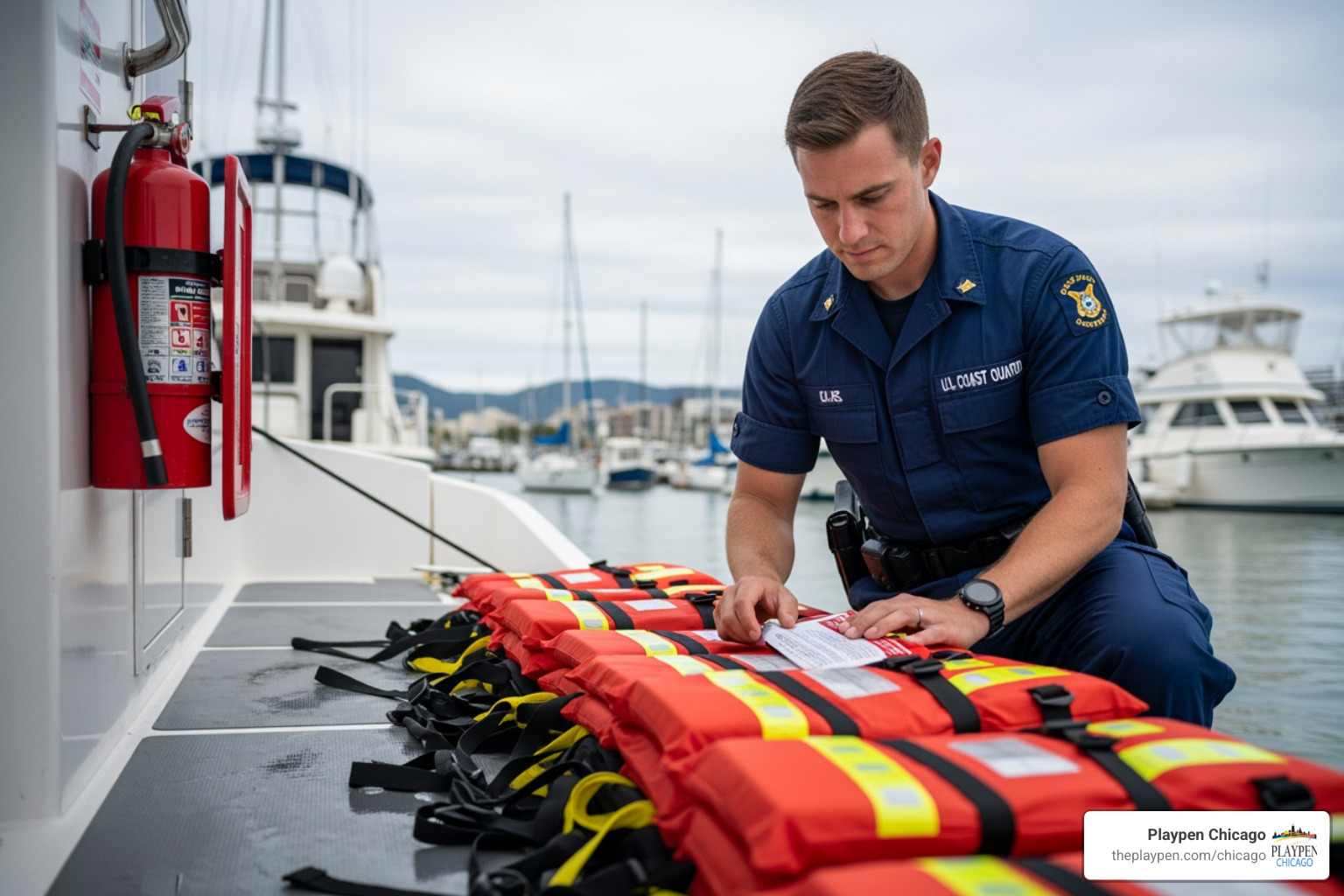
When we talk about USCG charter regulations, bareboat & passenger limits, we’re primarily concerned with how passengers are counted and the vessel’s Gross Tonnage (GRT). The GRT is a measure of a vessel’s internal volume and is a key factor in determining passenger vessel classifications and limits.
Defining ‘Passenger’, ‘Passenger for Hire’, and ‘Consideration’
The USCG has precise definitions for who counts as a “passenger” and what makes them a “passenger for hire.” This is where things can get a little tricky, but our understanding is key to staying compliant.
- Passenger: A “passenger” is generally anyone carried on a vessel, with a few important exceptions. Historically, in bareboat charters, everyone on board was considered part of the charter party or guests. However, the Passenger Vessel Safety Act of 1993 clarified this. Now, everyone on board a chartered vessel is considered a passenger except the individual owner or charterer (the person who signed the bareboat agreement), the master (captain), or the crew.
- Passenger for Hire: This is a critical distinction. A “passenger for hire” is a passenger for whom “consideration” is contributed as a condition of carriage. This consideration can be directly or indirectly given to the owner, charterer, operator, or anyone with an interest in the vessel.
- Consideration: Think of “consideration” as any economic benefit, inducement, right, or profit. This includes direct pecuniary payment. However, the USCG makes a very important clarification: a voluntary sharing of the actual expenses of the voyage (like splitting the cost of fuel, food, or beverages) is not considered “consideration.” This means if your friends chip in for gas on a recreational outing, they aren’t automatically “passengers for hire.”
So, who is not a passenger? The owner (or their representative), the charterer (or their representative), the Master (captain), and any crew members engaged in the business of the vessel who haven’t contributed consideration and are paid for their services. Everyone else on board is a passenger, and if they’ve paid for their spot, they’re a “passenger for hire.”
Key passenger limits under uscg charter regulations, bareboat & passenger limits
The number of people we can have on board our vessel on Lake Michigan depends heavily on its classification and operational status. Here’s a straightforward breakdown of the key passenger limits:
| Vessel Type / Operation | Passenger Limit |
|---|---|
| Recreational Vessel (no consideration) | No passenger limit (subject to vessel’s safe capacity) |
| Bareboat Charter | 12 passengers maximum |
| Uninspected Passenger Vessel (UPV) < 100 GRT | 6 passengers for hire maximum |
| Uninspected Passenger Vessel (UPV) > 100 GRT | 12 passengers for hire maximum |
| Inspected Passenger Vessel (with COI) | More than 12 passengers (as specified on the COI) |