
USCG license requirements: Ultimate 2025 Checklist
Why Understanding USCG License Requirements Matters
USCG license requirements are the foundation for anyone looking to operate a vessel professionally or take paying passengers on the water. Whether you dream of captaining charter boats on Lake Michigan, leading yacht outings for exclusive events, or building a career in the maritime industry, understanding these requirements is your first step toward making it happen.
Quick Answer: Core USCG License Requirements
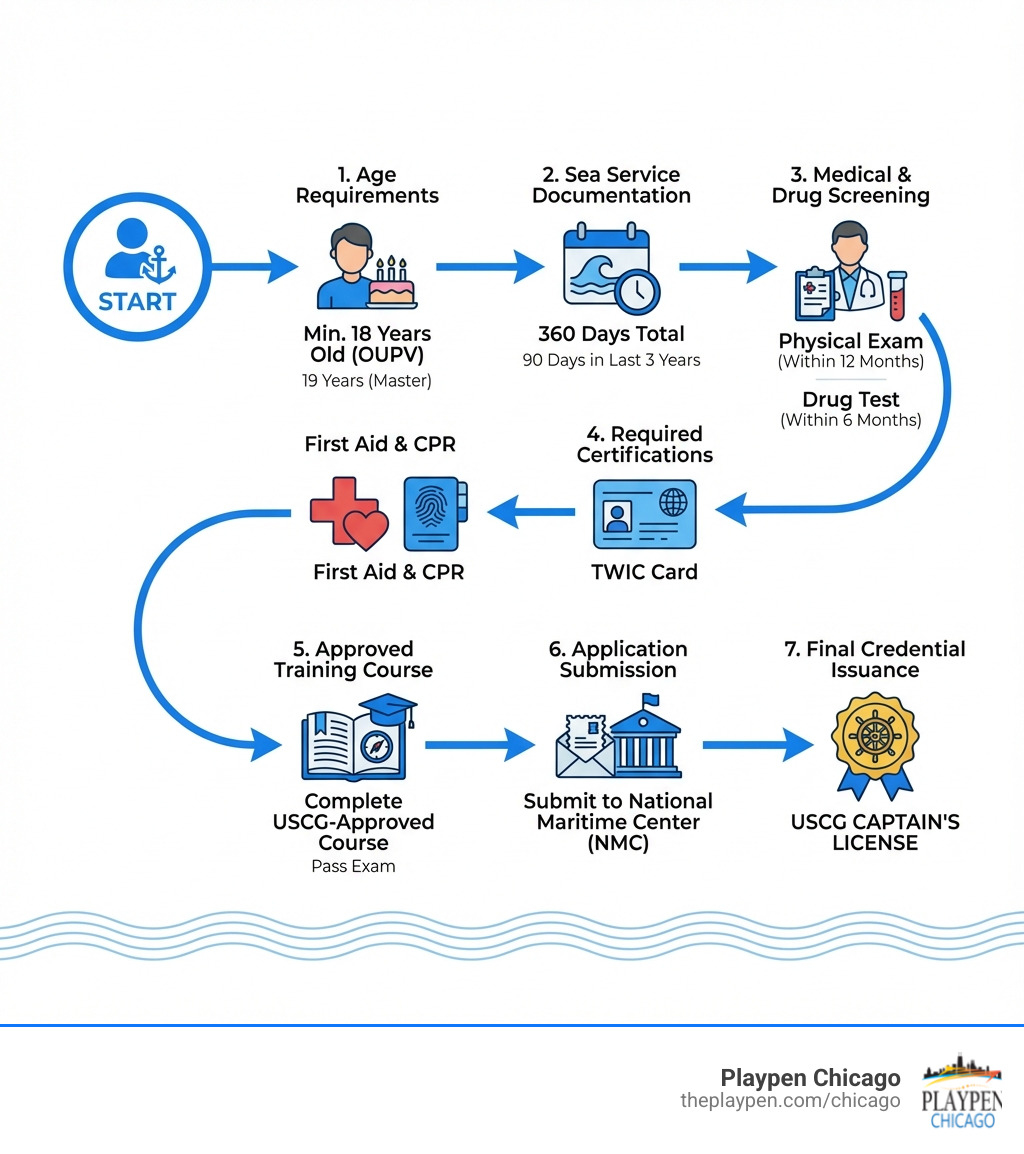
To obtain a USCG captain’s license, you must meet these essential criteria:
- Age: At least 18 years old (OUPV) or 19 years old (Master)
- Sea Service: Minimum 360 days of documented experience, with 90 days in the last 3 years
- Medical Clearance: Physical exam (within 12 months) and drug test (within 6 months)
- Training: First Aid and CPR certifications
- Security: Transportation Worker Identification Credential (TWIC)
- Education: Completion of a USCG-approved training course and exam
- Citizenship: U.S. citizen or meet specific exceptions
The path to becoming a licensed captain might seem complex, but it’s a rigorous process designed to ensure passenger safety and professional competence on the water. The average annual wage for captains, mates, and pilots of water vessels was $83,150 in 2015, making this credential not just a legal requirement but a valuable career asset.
This guide breaks down every requirement, walks you through the application process step by step, and helps you understand which type of license fits your goals. Whether you’re aiming for the OUPV “6-pack” license for smaller charters or a Master license for larger vessels, you’ll find everything you need to chart your course toward certification.
Understanding the Types of USCG Captain’s Licenses
When we talk about USCG license requirements, one of the first things to clarify is the type of license you need. The U.S. Coast Guard offers different credentials based on the kind of vessel you’ll operate, the number of passengers you’ll carry, and the waters you’ll steer. For those of us looking to make waves on Lake Michigan and beyond, the two primary licenses you’ll encounter are the Operator of Uninspected Passenger Vessels (OUPV), often called the “6-Pack,” and the Master Captain’s License.
The key distinction between these licenses often comes down to whether the vessel you’re operating is “inspected” or “uninspected” by the Coast Guard. Uninspected vessels, as the name suggests, are generally smaller and carry fewer passengers. Inspected vessels, on the other hand, are built to rigid USCG standards and are approved to carry more passengers, often requiring a Certificate of Inspection (COI) that dictates their operational limits.
Your choice of license will also be influenced by the gross tonnage (GRT) of the vessel and the specific geographic routes you intend to cover, such as Inland Waters (like much of Lake Michigan) or Near Coastal Waters. Let’s explore the specifics of each.
| Feature | OUPV “6-Pack” License | Master License (25/50/100 Ton) |
|---|---|---|
| Tonnage | Up to 100 Gross Registered Tons | Up to 100 Gross Registered Tons (25, 50, or 100-ton versions) |
| Passenger Count | Up to 6 paying passengers | More than 6 paying passengers |
| Vessel Type | Uninspected vessels | Inspected vessels |
| Experience Required | 360 days (90 in last 3 years) | 360 days (90 in last 3 years) for Inland/Great Lakes; 720 days (360 on Near Coastal) for Near Coastal |
| Operating Waters | Inland, Great Lakes, or Near Coastal (depending on sea service) | Inland, Great Lakes, or Near Coastal (depending on sea service) |
The OUPV “6-Pack” License
The Operator of Uninspected Passenger Vessels (OUPV) license is your go-to if you plan to carry up to six paying passengers on uninspected vessels. This is a common choice for charter fishing guides, small tour operators, and those offering private boat experiences on Lake Michigan. The “6-Pack” moniker simply refers to the six-passenger limit, crew not included.
To qualify for an OUPV license, you must be at least 18 years old and document a minimum of 360 days of boating experience on a vessel. A crucial detail for those of us on Lake Michigan is that 90 of those days must be on Ocean or Near Coastal waters to avoid a limitation to Inland Waters only. This ensures you have experience in conditions typical of the Great Lakes. The license is always limited to vessels under 100 gross tons. This license allows us to offer intimate, personalized experiences, which is perfect for many of the excursions popular in Chicago.
The Master Captain’s License (25/50/100 Ton)
If your ambitions involve operating larger vessels or carrying more than six paying passengers, the Master Captain’s License is what you’ll need. This license is required for “inspected” vessels, which means they’ve undergone rigorous USCG safety checks and possess a Certificate of Inspection (COI). This COI specifies the maximum number of passengers the vessel can carry and the required license level for its captain. Think ferry boats, larger tour boats, or water taxis that operate around the Chicago River and Lake Michigan.
The Master license comes in different tonnage ratings: 25-ton, 50-ton, or 100-ton. The specific tonnage you’re eligible for is determined by your documented sea service experience and the size of the vessels you’ve operated. To apply for a 25/50 or 100-ton Master Captain’s license, you must be at least 19 years old. You’ll need a minimum of 360 days of boating experience since age 16, with ninety of those days occurring in the last three years. For a Master license for Near Coastal Waters, the requirements are higher, demanding 720 days of experience, with at least 360 days specifically on Near Coastal or Ocean waters.
For those interested in operating sailing vessels, a sailing endorsement can be added to your Master Inland/Great Lakes license with 180 days on sail or auxiliary sail vessels, or 360 days for a Master Near Coastal license. This opens up even more possibilities for unique charter experiences on Lake Michigan. You can find more details about sailing endorsements here: Sailing endorsement.
The Core USCG License Requirements You Must Meet

This section details the fundamental prerequisites for all aspiring captains, forming the foundation of your application. Obtaining a USCG license isn’t just about passing an exam; it’s about demonstrating a proven track record of experience, physical capability, and good character. These USCG license requirements are designed to ensure that every licensed captain is competent and trustworthy, especially when responsible for the safety of passengers on Lake Michigan.
Age and Citizenship
First things first, let’s talk about who can apply. The USCG sets clear age minimums:
- For an OUPV license, you must be at least 18 years old.
- For a Master Captain’s license (25/50/100-ton), you must be at least 19 years old.
In addition to age, U.S. citizenship is generally required for officer endorsements. While there are some limited exceptions for non-U.S. citizens operating uninspected passenger vessels, most applicants will need to be U.S. citizens. These age and citizenship requirements are non-negotiable. For a comprehensive look at general eligibility, you can refer to the Coast Guard’s information page: General eligibility requirements.
Sea Service Time: Documenting Your Experience
This is where your time on the water truly pays off! Documenting your sea service is one of the most critical USCG license requirements. The Coast Guard needs to see that you have sufficient practical experience operating vessels.
- The 360-Day Rule: For both OUPV and Master licenses, you must document a minimum of 360 days of boating experience. This experience can be accumulated since you were 16 years old.
- Recency Requirement: Ninety of those 360 days must have occurred in the last three years immediately preceding your application. This ensures your experience is current and relevant.
- What Counts as a Day?: A “day” of service is defined as four hours underway in one day aboard a boat of less than 100 gross tons. So, even a half-day outing on Lake Michigan can count towards your total!
- Documenting Your Service: You’ll need to carefully record your sea service on a specific form, CG-719S. This form requires details about the vessel, dates, locations, and your role. Make sure to have it signed by the vessel’s owner or another licensed captain. We can’t stress enough how important accurate and thorough documentation is here.
- Near Coastal vs. Inland Experience: The type of waters you gain experience on significantly impacts the scope of your license.
- For an OUPV license, 90 days of your sea service must be on Ocean or Near Coastal waters (which includes Lake Michigan) to avoid your license being limited to Inland Waters only.
- For a Master license for Near Coastal Waters, you’ll need 720 days of total experience, with at least 360 days specifically on Near Coastal/Ocean waters.
- Experience on Inland Waters and the Great Lakes (like Lake Michigan) is crucial for those operating primarily in our local area.
To fully understand what specific activities and roles count towards sea service, it’s highly recommended to consult the official USCG document: What Counts as Sea Service.
Medical, Physical, and Drug Screening
Your physical and mental fitness are paramount when you’re responsible for a vessel and its passengers. The Coast Guard has rigorous standards to ensure you’re ready for anything the job demands.
- Physical Exam: You must pass a comprehensive physical examination, conducted by a licensed physician, within 12 months of your application date. This exam assesses your overall health, including vision standards and hearing standards.
- Drug Test: A drug test, approved by the USCG, must be taken within six months of your application. It’s crucial to remember that despite varying state laws, marijuana remains federally illegal. A positive test result will prevent you from obtaining a license, so federal drug policy must be strictly adhered to.
- Character: The USCG also evaluates your character. This involves a background check with fingerprinting to ensure you meet their safety and suitability standards.
Required Training and Certifications
Beyond your practical experience, certain formal training and certifications are mandatory for all aspiring captains.
- First Aid Certification: You’ll need to hold a valid Adult CPR and First Aid card. This certification must be current and obtained from an approved provider, typically within 12 months of your application.
- CPR Certification: Hand-in-hand with First Aid, current CPR certification is a must. These skills are vital for responding to emergencies on board.
- Transportation Worker Identification Credential (TWIC): This is a federal security credential required for all personnel who need unescorted access to secured areas of ports, vessels, and outer continental shelf facilities. You’ll apply for a TWIC card separately through the Transportation Security Administration (TSA).
- Approved Captain’s License Course: Perhaps the most significant training requirement is completing a Coast Guard-approved captain’s license course. This course covers a wide range of maritime knowledge essential for safe and legal operation.
Your Step-by-Step Guide to the Application Process
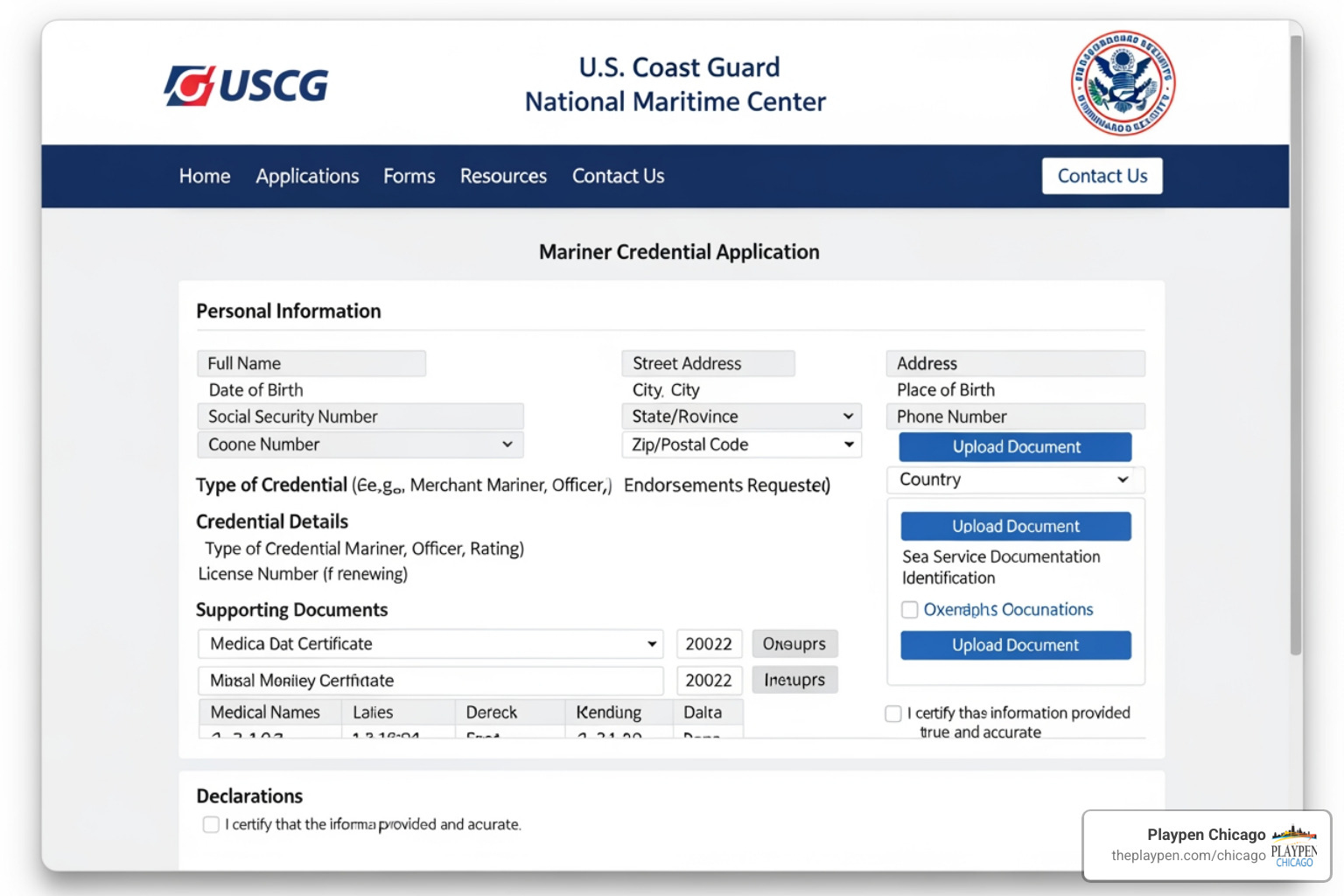
Navigating the application process for your USCG license can feel like charting a complex course. But with a clear understanding of each step, we can steer you from preparation to receiving your credential in the mail. This systematic approach ensures all USCG license requirements are met efficiently, paving your way to captaining vessels on Lake Michigan.
Step 1: Complete an Approved Training Course
Your journey formally begins with education. Enrolling in a USCG-approved captain’s license course is not just a requirement; it’s an investment in your knowledge and skills.
- Finding a USCG-Approved School: Look for training providers approved by the National Maritime Center (NMC). These schools offer curricula designed to meet Coast Guard standards. Many reputable institutions offer courses specific to Inland/Great Lakes and Near Coastal operations, perfectly suiting our Chicago waters.
- Classroom vs. Online Learning: You’ll often have the option for traditional classroom instruction or flexible online learning. Both formats cover the essential material.
- Course Content: These courses are comprehensive, covering critical topics such as:
- Rules of the Road: The international and inland navigation rules to prevent collisions.
- Navigation: Chart plotting, electronic navigation, and understanding aids to navigation on Lake Michigan.
- Boating Safety: Regulations, emergency procedures, and vessel stability.
- Environmental Responsibilities: Protecting our precious waterways.
- Captain’s Responsibilities: Legal duties, passenger management, and leadership.
- Passing the Exam: At the end of the course, you’ll take an exam (or a series of exams). Successfully passing this is a key milestone. Courses can range from eight days to two and a half weeks of intensive learning and examinations, with prices varying from a few hundred to around $1,500.
Step 2: Assemble Your Application Package
Once you’ve completed your training, it’s time to gather all your documentation. Think of this as preparing your manifest before a long voyage – every item must be present and accurate.
- USCG Application Form: Fill out the official application form (CG-719B) completely and accurately.
- Proof of Sea Service: Your carefully documented form CG-719S, detailing your time on the water.
- Medical and Drug Test Results: The official reports from your physical exam and drug screening. These have specific validity periods (12 months for physical, 6 months for drug test).
- TWIC Card Copy: A clear copy of your Transportation Worker Identification Credential.
- Training Certificates: Certificates proving completion of your USCG-approved captain’s course, First Aid, and CPR.
- Character References: Typically, you’ll need three character references who can attest to your good conduct and suitability for the role of captain.
We highly recommend using the official checklist provided by the National Maritime Center to ensure nothing is missed. It’s your best friend in this process: Use the official NMC Checklist.
Step 3: Submit to the National Maritime Center (NMC)
With your complete package in hand, the next step is submission.
- Regional Examination Center (REC): You must submit your application package to a Regional Examination Center (REC). While there isn’t one directly in Chicago, you’ll submit to the nearest REC, which then forwards your application to the National Maritime Center (NMC) for evaluation. It’s vital to include all supporting documentation and proper signatures, as missing information can cause significant delays or even rejection. You have 365 days from completing your approved course to submit all materials to the USCG for processing.
- Application Evaluation: The NMC will thoroughly review your application to verify that all USCG license requirements have been met. This evaluation process can take several weeks or even months.
- Check Your Application Status: Patience is a virtue, but you can also keep an eye on your application’s progress. The NMC offers a convenient online tool to check the status of your application without needing to call or email: Check your application status.
- Credential Mailing: Once your application is approved, congratulations! Your official Merchant Mariner Credential (MMC) will be mailed to you. You’re now a licensed USCG Captain, ready to take the helm on Lake Michigan.
Maintaining and Renewing Your Captain’s License
Earning your USCG Captain’s License is a significant achievement, but it’s not a one-time affair. Your license is a living document that requires periodic renewal to remain valid for professional use. Just as we maintain our vessels to ensure they’re always seaworthy, we must maintain our credentials to stay compliant with USCG license requirements.
The 5-Year Renewal Cycle
All USCG licenses must be renewed every five years. This regular cycle ensures that licensed captains remain current with health standards and continue to meet the Coast Guard’s professional expectations.
- Renewal Requirements: When it’s time to renew, you’ll need to submit a renewal application.
- No Written Exam for Renewal: The good news is that for renewals, you typically won’t need to retake the written examination. The Coast Guard recognizes your continued experience and professional conduct.
- Physical and Drug Test Required: However, you will need to undergo another physical examination and drug test. These must meet the same standards as your initial application, ensuring your ongoing fitness for duty. Make sure these are completed within the specified validity periods before submitting your renewal application.
Upgrading Your License
The maritime world offers continuous opportunities for growth, and your captain’s license can grow with you. Many captains start with an OUPV license and later choose to upgrade to a Master license.
- Path from OUPV to Master: If you hold an OUPV license and gain additional sea time on qualifying vessels, you can pursue an upgrade to a Master license. This often involves accumulating more sea service (especially on inspected vessels if you’re aiming for that endorsement) and potentially taking additional examinations on topics specific to Master-level responsibilities.
- Increasing Tonnage Endorsements: As you gain more experience on larger vessels, you can also apply to increase your tonnage endorsement (e.g., from 25-ton to 50-ton, or 50-ton to 100-ton). This requires documenting the appropriate sea time on vessels of the higher gross tonnage.
- Gaining Additional Sea Time: The key to any upgrade is often more documented sea service. Keep that logbook handy!
- Additional Examinations: Depending on the upgrade, you may need to pass further examinations to demonstrate competence at the higher license level or for specific endorsements.
Frequently Asked Questions about USCG Licensing
We understand that USCG license requirements can raise many questions. Here, we address some of the most common inquiries to help you steer your journey.
What is the difference between a state boating certificate and a USCG Captain’s License?
This is a common point of confusion, especially for recreational boaters.
- State Boating Certificate: Many states, including Illinois, require recreational boaters to complete a boating safety course and obtain a state boating certificate (sometimes called a “boating safety card” or “boating license”). These requirements often depend on your age and the horsepower of your vessel. For example, in many states, if you were born after a certain date, you need this certificate to operate a motorboat. This is purely for recreational operation.
- USCG Captain’s License: A USCG Captain’s License, on the other hand, is a federal credential. It is specifically required if you intend to operate a vessel commercially, which means carrying passengers or cargo for hire, or if you get paid to operate an auxiliary-powered boat in waters patrolled by the USCG (including Lake Michigan). This license signifies a higher level of training, experience, and responsibility. In short, if you’re getting paid to be at the helm, you need a USCG license, not just a state certificate.
How long does the entire process take from start to finish?
The timeline for obtaining your USCG Captain’s License can vary, but it’s important to set realistic expectations. It’s not an overnight process.
- Course Duration: The USCG-approved training courses themselves can range from a few weeks to several months, depending on whether you choose an accelerated in-person program or a more flexible online option.
- Application Processing Time: Once you submit your complete application package to the REC, the National Maritime Center (NMC) begins its evaluation. This processing time can vary significantly based on the volume of applications and the complexity of your file. It’s common for this evaluation to take several weeks to a few months.
- Overall Timeline: From starting your course to receiving your credential in the mail, we often see the entire process take anywhere from a few months to six months or more. Planning ahead and ensuring your application is carefully prepared are key to minimizing delays.
Can I get a USCG license if I have a criminal record?
The USCG conducts a thorough background check as part of the application process. Having a criminal record does not automatically disqualify you, but it does mean your application will undergo a more detailed review.
- Safety and Suitability Evaluation: The Coast Guard evaluates applicants based on “Safety and Suitability” standards. They consider the nature of the crime, how long ago it occurred, and the circumstances surrounding it.
- Case-by-Case Basis: Each case is reviewed individually. Minor offenses from many years ago might be less impactful than recent, serious offenses.
- Disclosable Offenses: It is crucial to be completely honest and disclose any criminal history on your application. Failure to disclose can lead to immediate disqualification, even if the offense itself might not have been a barrier.
- Consulting with the USCG: If you have a criminal record, we strongly recommend consulting directly with the USCG or a maritime legal professional before investing time and money in the application process. They can provide guidance on your specific situation to determine your eligibility.
Conclusion: Chart Your Course as a Licensed Captain
Starting on the journey to obtain your USCG Captain’s License is a commitment, but one that opens up a world of opportunities on Lake Michigan and beyond. We’ve steerd through the various types of licenses, digd into the essential USCG license requirements from age and sea service to medical certifications, and outlined the step-by-step application process. We’ve also touched on the importance of maintaining your credential and answered some common questions.
A USCG license is more than just a piece of paper; it’s a testament to your skill, dedication, and adherence to the highest standards of maritime safety and professionalism. It open ups career paths, from leading exclusive yacht outings on Lake Michigan to operating commercial charter services, offering a significant earning potential.
For those of us in Chicago, with our vibrant boating culture centered around the iconic Playpen, becoming a USCG-licensed captain means you’re uniquely positioned to thrive. Playpen® Chicago is dedicated to connecting boat owners, charter operators, and captains like you with a community eager for premium on-water experiences.
If you’re ready to take the helm and turn your passion for boating into a profession, we encourage you to take the next step.