
Raise a Glass: Navigating Drinking on Chicago Boats
Your Guide to Chicago’s Boat Drinking Culture
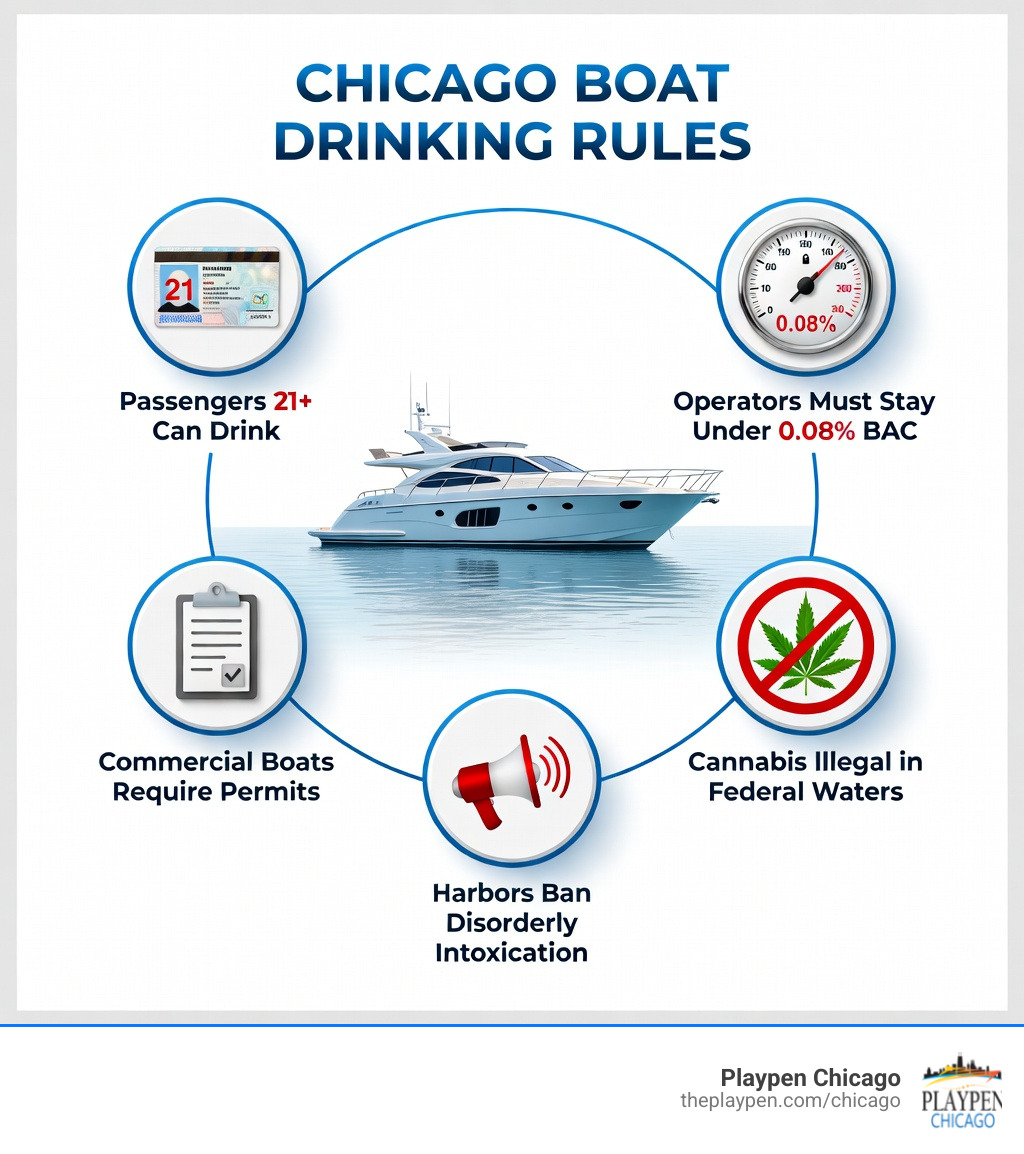
Can you drink on boats in chicago? The short answer is yes—but with important rules. Here’s what you need to know:
- Passengers 21+ can legally drink alcohol on boats in Chicago
- Boat operators must remain sober (under 0.08% BAC)
- Commercial boats need special permits to serve alcohol
- Cannabis is illegal on Lake Michigan (federal waters)
- Chicago Park District harbors prohibit intoxication that disturbs others
Chicago’s boating scene offers a unique blend of urban excitement and waterfront freedom. One visitor to Navy Pier last summer noticed something surprising: “My wife and I bought cocktails at Navy Pier and saw people drinking on tour boats… Chicago is unusually lenient on public alcohol compared to Northeast cities.”
This observation captures an important truth about Chicago’s boat culture. While Illinois law prohibits operating a vessel under the influence, passengers are free to enjoy alcoholic beverages responsibly. The distinction matters—especially on Lake Michigan, where 70 boating accidents occurred in 2023, with 2 of the 12 fatalities involving alcohol or drug impairment.
Understanding where and how you can drink on boats requires navigating a mix of federal regulations, state laws, and local ordinances. The Chicago River, Lake Michigan, and harbor systems each have specific rules. Commercial booze cruises operate under different standards than private bareboat charters. And certain locations like the famous Playpen have their own cultural norms alongside legal requirements.
I’m Heidi Auvenshine, Partnership and Marketing Director for Playpen Chicago, and I’ve spent years helping people navigate can you drink on boats in chicago regulations while creating memorable on-the-water experiences. My work connecting boaters, charter guests, and captains has given me deep insight into Chicago’s waterfront social scene and the rules that keep it safe.
Understanding the Law: Can You Drink on Boats in Chicago?

When we talk about whether can you drink on boats in chicago, we have to look at the Illinois Boat Registration and Safety Act. This state law is the primary authority for our local waters. In Chicago, public consumption of alcohol on land is generally restricted—you can’t just walk down Michigan Avenue with an open beer without risking a $250 fine. However, boats are treated differently.
A private vessel is often viewed as a “private residence” of sorts while on the water. This means that once you leave the dock and are out on the Chicago River or Lake Michigan, the strict public way ordinances of the city soften. But don’t let the relaxed vibe fool you; the law is very specific about who can have a drink in their hand and who must keep their eyes on the horizon. For a deeper dive into the specifics, check out our guide on Chicago boating laws and safety.
Staying Sober at the Helm
The most critical rule for can you drink on boats in chicago applies to the person driving. In Illinois, it is illegal to operate any watercraft while under the influence of alcohol, drugs, or a combination of both. The legal Blood Alcohol Concentration (BAC) limit for boat operators is 0.08%, exactly the same as it is for driving a car on I-90.
The state uses the term “Operating Under the Influence” (OUI). It’s important to understand that “operating” doesn’t just mean cruising at full throttle. Authorities look for “actual physical control.” If you are at the helm and the engine is running—or even if you are the one responsible for the vessel while it’s drifting—you are the operator. The boating safety handbook published by the IDNR emphasizes that alcohol is a factor in a significant percentage of boating fatalities. In 2023 alone, there were 72 OUI arrests in Illinois waters, showing that the Conservation Police are actively looking for impaired drivers.
Can you drink on boats in Chicago as a passenger?
If you aren’t the one steering the ship, the news is much better. Passengers are legally allowed to drink alcohol on boats in Chicago, provided they are 21 years of age or older. There is no state-wide “open container” law for boat passengers like there is for motor vehicles.
However, being a passenger doesn’t mean “anything goes.” We always recommend moderate consumption for a few reasons:
- Environmental Stressors: Sun, wind, and the motion of the waves can actually intensify the effects of alcohol, a phenomenon known as “boater’s hypnosis.”
- Safety Hazards: Most boating injuries involve people falling overboard or slipping on wet decks. Excessive drinking significantly increases these risks.
- Life Jackets: Statistics show that 8 out of 12 fatalities in 2023 involved victims not wearing life jackets. If you are drinking, you are less likely to properly secure your safety gear in an emergency.
Passenger Best Practices:
- Designate a Sober Captain: Ensure the person in charge remains at 0.0% BAC.
- Hydrate: Drink one bottle of water for every alcoholic beverage.
- Stick to Cans: Glass bottles are dangerous on a moving boat and are often banned by charter companies.
- Know Your Limit: Don’t get so intoxicated that you become a safety liability for the rest of the crew.
Navigating Specific Locations: Harbors, Navy Pier, and The Playpen
Where you are in Chicago changes the rules slightly. The water isn’t a legal “wild west”; different zones are managed by different entities. The most famous spot for social boating is the Playpen, located just south of Ohio Street Beach. If you’re heading there, make sure to read our ultimate guide to the Chicago Playpen.
Chicago Park District Harbor Rules
The Chicago Park District Harbor Rules govern the 10 harbors along Chicago’s lakefront, from Montrose to 31st Street. While you can generally drink on your boat while it is moored in its slip, the Park District has “conduct guidelines” that are strictly enforced.
If your intoxication leads to disorderly conduct, disturbs other permit holders, or causes harm, the consequences are severe. The Park District has the authority to immediately terminate your boat permit. Furthermore, fines for violating harbor rules can reach up to $500 per incident. Commercial boats operating in these harbors are also prohibited from selling or permitting alcohol use without specific written approval from harbor management.
Drinking on the Chicago River and Navy Pier
The Chicago Riverwalk and Navy Pier are unique because they are some of the few places in the city where “to-go” drinking is somewhat tolerated in specific zones.
- Navy Pier: You can buy a cocktail and walk with it outside on the Pier, but you must dispose of it before you exit the front gates.
- Chicago Riverwalk: Certain areas are fenced or marked for alcohol consumption.
- Public Transit: While you might see people drinking on Metra trains (which often tolerate it except during major festivals), drinking is strictly prohibited on the CTA (L-trains and buses), with fines reaching $250.
On the river itself, you’ll see architectural tours and “booze cruises” with full bars. These are legal because the vessels hold specific commercial licenses.
Commercial Cruises vs. Private Bareboat Charters
How you get on the water determines how you get your drinks. There is a big legal difference between a boat that sells you a drink and a boat where you bring your own.
Alcohol on commercial booze cruises in Chicago
Commercial vessels—like the themed “Swiftie” cruises or sunset cocktail tours—operate with a Commercial Passenger Vessel (CPV) license. These boats are essentially floating bars and restaurants. They must pass rigorous USCG safety inspections and often carry a Certificate of Inspection (COI) if they carry more than 6 passengers.
On these cruises, you’ll find licensed bartenders and professional captains. These operators are responsible for your safety, meaning they can cut you off if you’ve had too much, just like a land-based bar.
BYOB and Bareboat Regulations
Many people prefer to rent a private yacht for a more intimate experience. This is often done through a “bareboat charter.” Under USCG charter regulations, a bareboat charter is limited to 12 passengers plus the charterer (13 total).
In a bareboat arrangement, you are essentially “owning” the boat for a few hours. This means you can Bring Your Own Beverages (BYOB). However, because you are the “owner,” you must hire a USCG-licensed captain separately.
| Feature | Commercial Cruise | Bareboat Charter |
|---|---|---|
| Alcohol Source | Cash Bar / Included | BYOB |
| Capacity | Often 20+ to 100+ | Max 12 Passengers |
| Captain | Provided by company | Hired separately by you |
| Glass Policy | Allowed (usually) | Often banned (Cans only) |
| Staining Liquids | Professional cleanup | Renter pays damage fees |
Pro-tip: Most private charters in Chicago ban red wine and cranberry juice because they permanently stain the white marine upholstery!
Prohibited Substances and Safety Essentials
While we’ve established that you can you drink on boats in chicago, there are some hard “nos” you need to be aware of.
Cannabis is a major trap for boaters. Even though recreational cannabis is legal in the State of Illinois, Lake Michigan and Chicago’s harbors are considered federal waters. Under federal law, cannabis remains a Schedule I controlled substance. The U.S. Coast Guard (USCG) has zero tolerance for cannabis on board vessels. If they board your boat for a routine safety check and find it, you could face federal charges, regardless of your Illinois medical card or state law.
Why “Can You Drink on Boats in Chicago” Requires a Designated Driver
Operating a boat is significantly more demanding than driving a car. As ICP Lt. Curt Lewis noted in the research, “On waterways, there are no lane markers, boats have no seatbelts, and there is little protection for occupants should a collision occur.”
The stats from 2023 are a sobering reminder of why we push for boat safety:
- 70 total accidents in Illinois waters.
- 12 deaths and 37 injuries.
- 72 OUI arrests, showing that law enforcement is not looking the other way.
Alcohol impairs your peripheral vision and your ability to distinguish between red and green navigation lights at night. When you combine that with the lack of “lanes” on Lake Michigan, you have a recipe for disaster if the operator isn’t sober.
Legal Consequences of Boating Under the Influence (BUI)
If you are caught operating a boat under the influence in Chicago, the party ends very quickly. The Illinois Conservation Police and the Chicago Police Marine Unit are the primary enforcers.
- First Offense: Typically a Class A misdemeanor. This can result in up to a year in jail and fines of up to $2,500.
- Aggravated BUI: If the OUI results in a crash that causes great bodily harm or death, or if it is a subsequent offense, it can be upgraded to a Class 4 felony. This carries a penalty of 1 to 3 years in state prison.
- License Impact: A BUI conviction can also impact your driving privileges on land, leading to the suspension of your driver’s license.
Frequently Asked Questions about Drinking on Chicago Boats
Does the law change if the boat is anchored versus underway?
In the eyes of Illinois law, not really. While federal rules focus on vessels “underway” (not at anchor), Illinois state law is broader. If you are in “actual physical control” of the boat, you must be sober. Even if you are anchored in the Playpen, if you are the only person on the boat who knows how to operate it and you are intoxicated, a conservation officer could argue you are in control of the vessel. It is always safest to have a designated, sober captain even while at anchor.
Is cannabis allowed on boats if it is legal in Illinois?
No. As mentioned earlier, the USCG operates under federal law. Because Lake Michigan is a federal waterway, Illinois state laws regarding cannabis do not apply once you are on the water. Keep it on land to avoid federal seizure of your vessel or heavy fines.
Can you drink on boats in Chicago if you are using a rental?
Yes, but you must follow the rental company’s specific policies. Most rental companies like those found through Playpen Chicago require the “charterer” (the person who signs the contract) to be at least 21 years old. They may also have rules against glass containers or specific types of alcohol that could damage the boat. Always check your rental agreement before boarding. If you’re looking to book, here is a guide on how to rent a boat for the Playpen.
Conclusion
Chicago’s summer is legendary, and there’s no better way to experience it than with a drink in hand and the skyline in view. Whether you are rafting up in the Playpen or taking a slow sunset cruise down the river, the answer to “can you drink on boats in chicago” is a resounding yes—as long as you do it responsibly.
At Playpen Chicago, we believe in fueling the city’s signature summer lifestyle while keeping our community safe. Our platform makes it easy to discover the best of Chicago boating, from finding a USCG-licensed captain who will stay sober for you, to joining exclusive yacht outings where you can relax as a passenger.
Ready to raise a glass on the lake? Create your free profile on Playpen Chicago today to connect with hosts, find last-minute boat seats via WaveMates™, and ensure your next Lake Michigan adventure is both high-end and high-safety.